


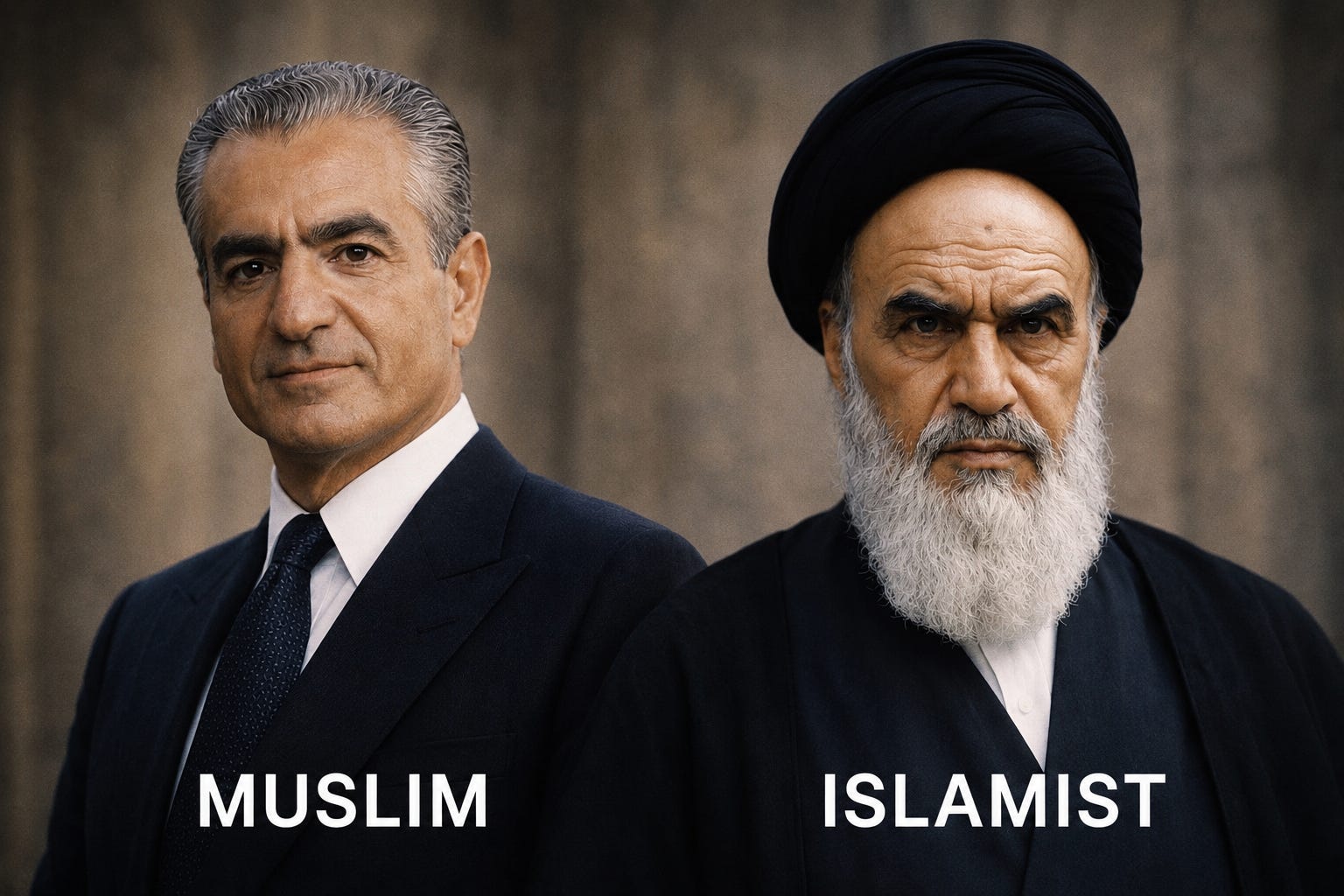
People are often surprised to learn that Reza Pahlavi is Muslim, and that so was his father, Mohammad Reza Pahlavi.
But why should that be surprising?
People seem to expect Muslim political figures to constantly foreground Islam in their rhetoric and governance in a way they do not expect from Western leaders with Christianity.
A Western leader can absolutely be Christian — genuinely Christian — while rarely talking explicitly about Christianity in political life. We do not conclude from this that they are secretly non-Christian or merely “culturally” Christian. We simply understand that they operate within a politically secular framework.
And historically, many Muslim leaders operated similarly.
Being Muslim does not inherently imply wanting clerical rule, theocratic governance, or constant religious framing of public life any more than being Christian inherently implies wanting Biblical governance.
The Pahlavis were Muslims. They were also politically secular modernizers. Those are not contradictory categories.
A great deal of confusion arises because many people unconsciously collapse “Muslim” and “Islamist” into the same thing. But Islamism is a particular political ideology concerning the role of Islam in governance and society. It is not synonymous with simply being Muslim, just as Christian nationalism is not synonymous with simply being Christian.
—
Islam ≠ Islamism Playlist
https://www.youtube.com/playlist?list=PLHmody2xNMCv2714BBzTCt5GIlb1LDjHz