


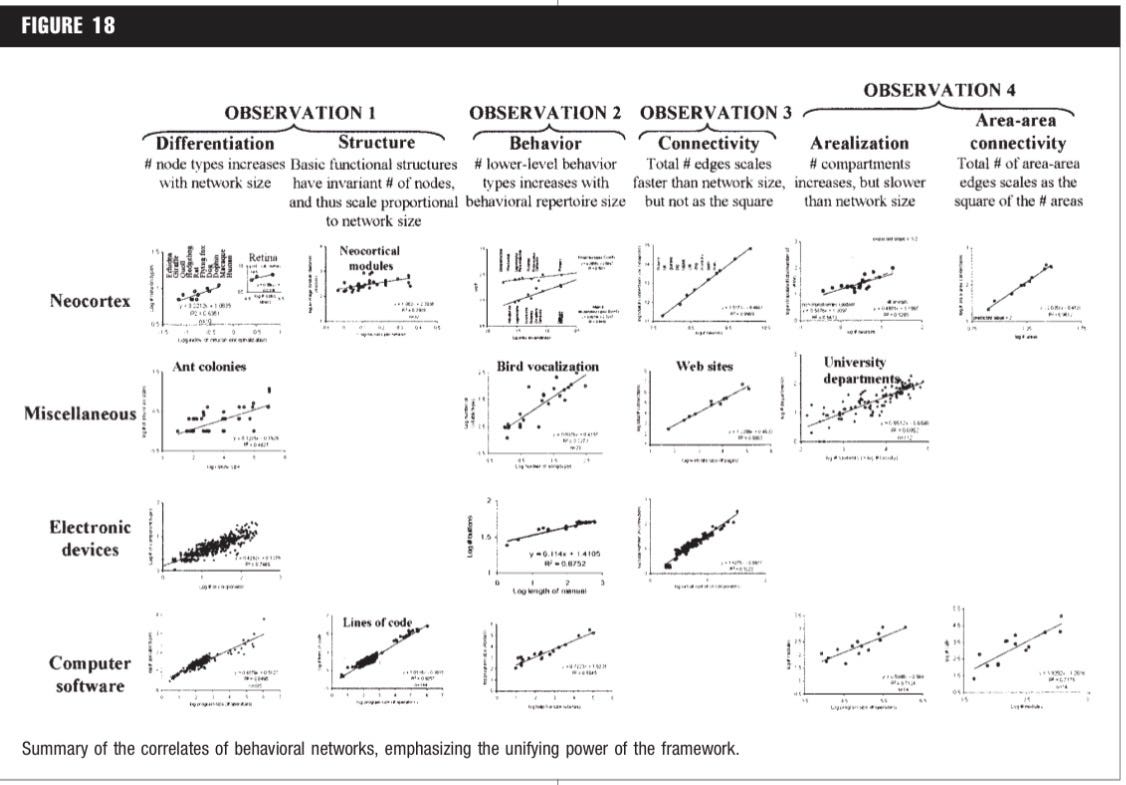
Twenty years ago, I noticed something curious. Systems as different as neocortices, ant colonies, computer software, electronic circuits, websites, bird vocalizations, and human organizations all face essentially the same challenge: how to generate increasingly large repertoires of behavior without becoming hopelessly inefficient.
My proposal was that this common problem should produce common organizational principles.
Across these remarkably different systems, the same broad scaling relationships appear. As behavioral repertoire grows, networks become more differentiated, acquiring new specialized component types. Their repertoire expands primarily by adding reusable lower-level structures rather than by making individual behaviors ever longer. Connectivity increases in a characteristic way, preserving efficient communication across the network. And as networks become larger, they become increasingly compartmentalized into semi-independent modules.
The first figure summarizes these empirical regularities across biological, social, and engineered systems.
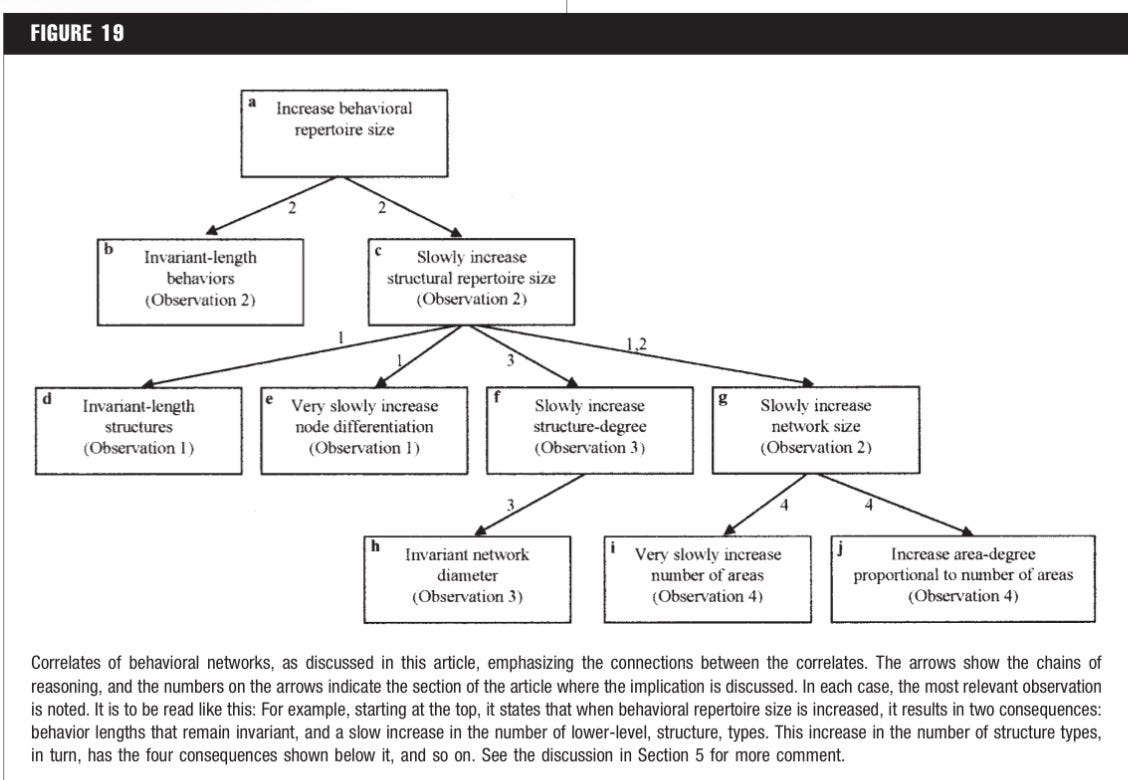
But the observations are not merely a list of correlations. The second figure shows that they arise naturally from one another. Once a system must support a growing repertoire of efficient behaviors, the remaining architectural consequences largely follow. A larger behavioral repertoire requires a larger repertoire of lower-level structures. Those structures must remain compact, which pushes the system toward greater differentiation. As the repertoire grows, connectivity must rise enough to preserve short paths through the network. And as the network enlarges, compartmentalization becomes necessary to keep organization and wiring manageable.
What appear to be separate properties are therefore different expressions of a common organizational constraint.
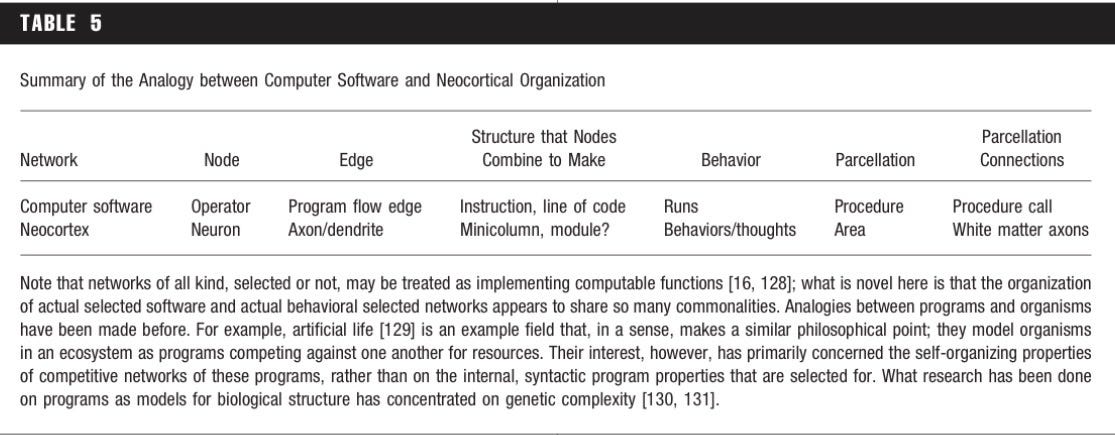
This framework also suggested a new way to think about the neocortex. Rather than asking only how neurons connect to one another, we should ask what the functional equivalents of software constructs might be. If neurons correspond roughly to operators, what corresponds to instructions, procedures, and procedure calls? The final table sketches this analogy: neurons combine into local functional structures, those structures participate in behaviors and thoughts, cortical areas resemble procedures, and white-matter connections resemble calls among procedures.
The claim was not that brains are literally computers. It was that networks selected to generate rich behavioral repertoires appear to converge on similar forms of organization, despite being built from radically different materials.
Computer software is especially revealing because its functional organization is comparatively visible. We can directly see operators, instructions, procedures, and calls among procedures. In biological networks, the equivalent units are far harder to identify. The analogy therefore offers a way of carving the neocortex at its functional joints.
The broader lesson is that behavioral networks may possess a common architecture. Brains, colonies, organizations, circuits, and programs are not merely complicated collections of connected parts. As their behavioral capabilities grow, they differentiate, acquire reusable structures, increase connectivity, and divide into compartments in systematic ways.
Studying these systems together may reveal principles that remain hidden when each is examined in isolation.
https://www.changizi.com/uploads/8/3/4/4/83445868/net.pdf