


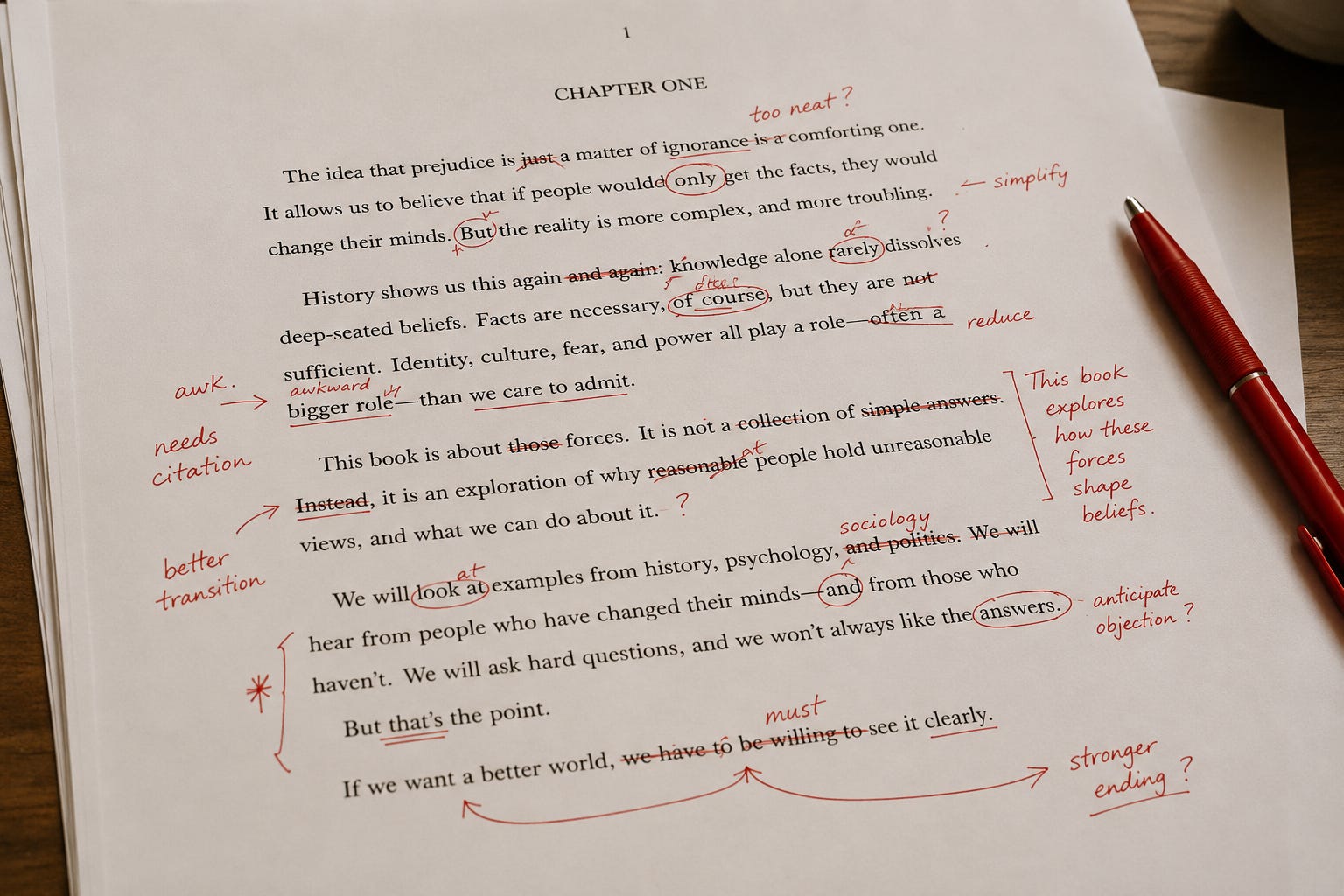
If you’ve ever read one of my books, you’ve already read prose that was heavily altered by copy editors. That’s literally part of publishing. They go through the manuscript line by line — rephrasing, cutting, tightening, reordering, smoothing transitions, flagging awkward wording, and generally helping the writing become clearer and more readable. Authors get too close to the prose to reliably see many of its flaws.
But nobody concludes from this that the copy editor “wrote the book.”
The ideas, arguments, structure, voice, worldview, examples, discoveries, and underlying intellectual labor are still the author’s.
AI editing tools are often functioning similarly — except faster, cheaper, and more interactive. They can help clean up prose, suggest phrasing, tighten paragraphs, or improve flow. But that’s very different from generating the underlying substance itself.
There’s a strange tendency right now to treat any AI involvement as if authorship has somehow evaporated. But by that logic, copy editors, spellcheckers, thesauruses, calculators, Photoshop, and research assistants would all count as “doing the work” too.
They don’t.
Spot on, Mark. Feature and function matter. Real free expression sees utility from the originator's mind and purpose on a continuing basis. Thanks again.