


More than a quarter century ago I became obsessed with a question that still drives my research today:
What does it actually mean to understand something?
At the time, neuroscience was becoming increasingly good at mapping the brain. Find all the parts. Trace every connection. Catalog every neuron. Important work, of course. But I worried we were mistaking a map for an explanation. I became convinced that real progress would require many more scientists asking a different class of questions—not merely How does the brain do this? but What engineering problem did evolution have to solve? Those are teleological questions—engineering questions. What is this for? Why this design rather than countless others? What higher-level principles constrain the space of possible solutions?
To explain what I meant, I opened my first book, The Brain From 25,000 Feet, with a thought experiment.
Imagine civilization collapses. A thousand years later, scientifically primitive humans stumble upon perfectly preserved 21st-century houses. The solar panels still work. Lights turn on. Refrigerators hum. Computers boot. The new humans move in. They quickly figure out what toilets, ovens, and light switches are for. But they have absolutely no idea how any of it works.
Naturally, they begin studying the houses. They painstakingly map every wire, every pipe, every beam. They catalog every component. They discover which parts connect to which others. Eventually they publish the complete blueprint of a house.
The newspapers celebrate.
“At last, houses understood!”
Except… they’re not.
They still know nothing about electricity. Nothing about plumbing. Nothing about computer science. Nothing about the engineering principles that made any of it possible. They have mapped the artifact, but they have not discovered the ideas that generated it.
That allegory wasn’t really about brains. It was about how science itself progresses. And it became the organizing philosophy behind nearly everything I’ve worked on since.
It led me to ask questions like:
~ Why are visual illusions inevitable? (compensating for neural delay)
~ Why did primates evolve red-green color vision? (reading emotions and physiological state)
~ Why do our fingers wrinkle in water? (improving wet grip)
~ Why do mammalian brains scale the way they do? (preserving network efficiency)
~ Why did some species evolve forward-facing eyes while others evolved side-facing eyes? (seeing through leafy clutter)
~ Why are letters shaped the way they are? (they look like opaque objects in natural scenes)
~ Why do speech sounds have the structure they do? (mimicking solid-object events)
~ Why does music have the structure it does? (sounding like a human moving evocatively in your midst)
~ Why do emotional expressions look the way they do? (the poker language of negotiation)
To me, these have never been separate projects. They are all attempts to uncover the higher-level engineering principles that make the details almost inevitable.
Ironically, the rise of AI has only strengthened that conviction.
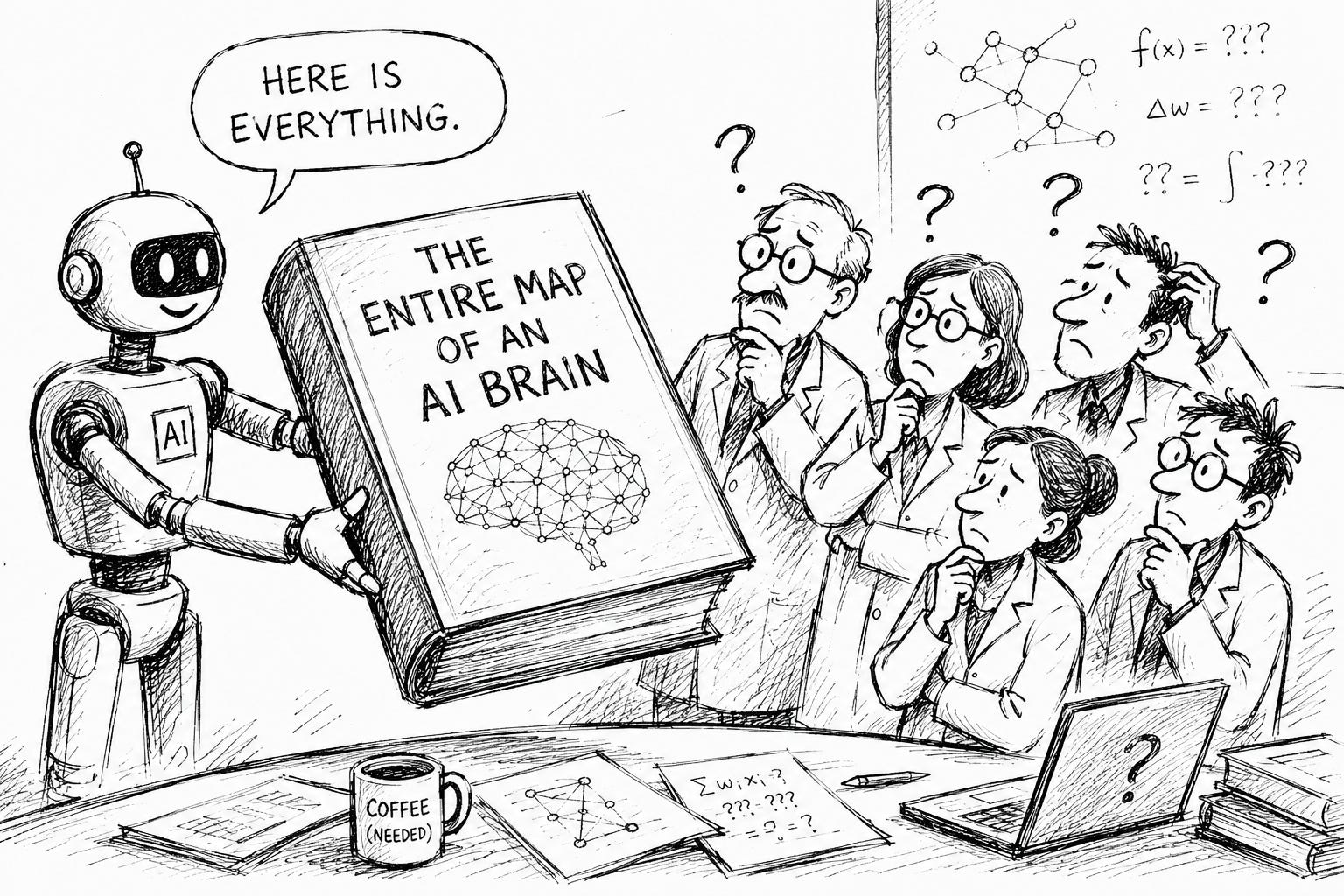
For the first time in history we possess an intelligent system whose “neuronal anatomy” we know almost perfectly. We know every weight. Every connection. Every activation. We can watch every signal flowing through the network. Twenty-five years ago I imagined futuristic scientists who could completely map an intelligent machine without understanding it.
We have become those scientists.
Before AI, we could always comfort ourselves with the idea that the mystery of thought persisted because the brain was simply too inaccessible. Too many neurons. Too many synapses. Too little data. Surely, if only we could map everything, understanding would follow.
AI has demolished that hope.
Here is a thinking machine whose internal workings are open to inspection in a way no biological brain ever will be. There is no magical hidden machinery left to blame. And yet the mystery remains. In some ways, it has become even more profound. We can inspect nearly everything that happens inside these systems, yet we still struggle to explain why particular concepts emerge, why particular capabilities appear, why certain internal representations form, or what general principles govern intelligence itself.
That should fundamentally change how we think about the science of mind.
The bottleneck was never just a shortage of measurements. It was—and still is—a shortage of theory. Not another atlas of parts. Not another trillion parameters. We need rigorous, foundational theories that explain why intelligent systems have the architectures they do, why certain computations are inevitable, and what engineering principles govern minds in the first place.
That was the message of The Brain From 25,000 Feet more than twenty-five years ago.
If anything, I believe it even more strongly today.