


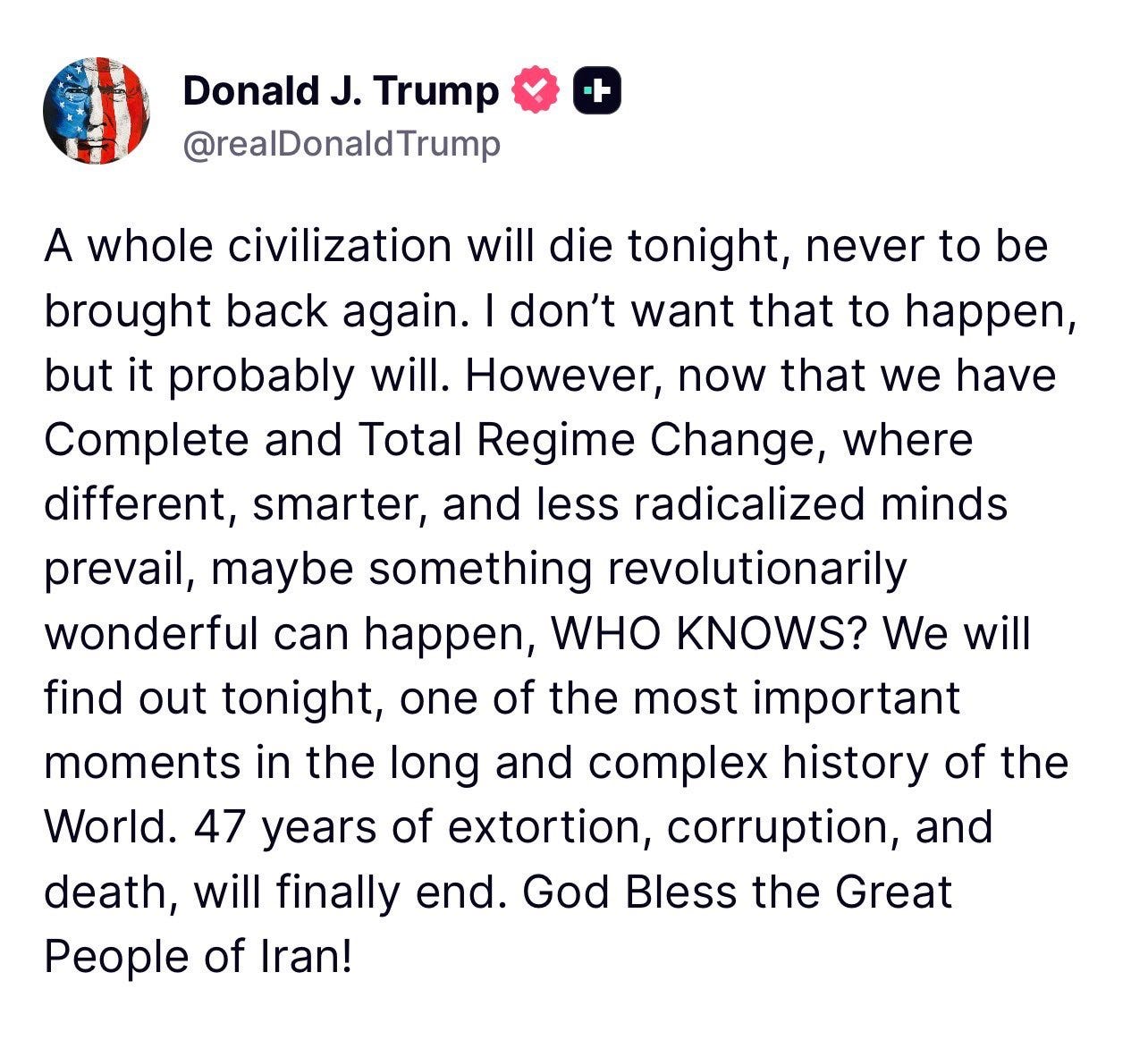
Yesterday, countless idiots were shitting themselves that Trump had just threatened to genocide Iranians. Which is bizarre, because by now they’ve had years of exposure to Trump posts and should have learned that something else is usually going on there besides an efficient attempt to state facts, intentions, or desires with clean propositional clarity.
What Trump — ahem, his team — is often doing is not mainly declaring propositions at all. It is much closer to signaling an emotional posture. Roughly: Grrrrr about Hormuz and the Islamic regime. The point is to project aggression, seriousness, and willingness to escalate if the other side doesn’t back down. But there’s a problem. You cannot literally post a raw emotional expression. He can’t just upload a five-second clip of himself making an enraged primate face and have that function as presidential signaling.
So the emotion has to be packaged in words. But once you package it in words, it starts to look like propositional content whether or not that is the real point. And this is where these posts become distinctive: the sentences are often made to crisscross, blur, overstate, shift referents, or partly contradict themselves precisely so that the post does not function mainly as a clean declarative statement. The propositional layer is being scrambled, or at least left strategically unstable, because what matters is not crisp assertion but the emotional and strategic signal riding through it.
What the post is actually trying to convey is something more like this: if you IRGC asshats keep pushing, and if you don’t back down and meet my demands by Tuesday evening, things are going to go very badly for you. Not badly in some abstract policy-paper sense. Not fucking well at all. That is the signal. The post is carrying information not principally about a carefully delimited state of affairs, but about how aggressive the signaler is, and how serious he is about carrying that aggression through.
And that is why these posts so often confuse the literalists. They read them as though their primary job were to cleanly map sentences onto facts. But the primary job is often to move the negotiation. Emotional signals carry two big kinds of information: how hard I’m pushing, and how ready I am to call — to abandon signal and fight about it. The context — the “it” all this is about — is usually already known. Here, it’s Hormuz, the regime, the threats, the deadline, the possibility of escalation. The post is not mainly there to teach you the context. It is there to intensify the posture within that context.
So yes, you end up with posts that look proposition-like but are really doing something older and more primitive. They are sentence-shaped emotional expressions. Language is being used less to state and more to signal: to project menace, resolve, impatience, contempt, and willingness to own the consequences. If you keep expecting those posts to behave like careful declarative prose, you will keep misunderstanding them. They are much closer to an angry face that has been forced to wear paragraphs.
[Find out more about what emotional expressions actually are in my book, Expressly Human.]