


Astronomers and science communicators love telling us there are trillions of galaxies and roughly 10^80 atoms in the universe.
Except, of course, they don’t know that.
Those are estimates for the observable universe — the portion from which light has had time to reach us. We don’t know the size of the universe as a whole. We don’t know what fraction of it we can see. We don’t even know whether its total spatial extent is finite.
And here’s the awkward part: even when they carefully include the word observable, the statistic is strangely inane.
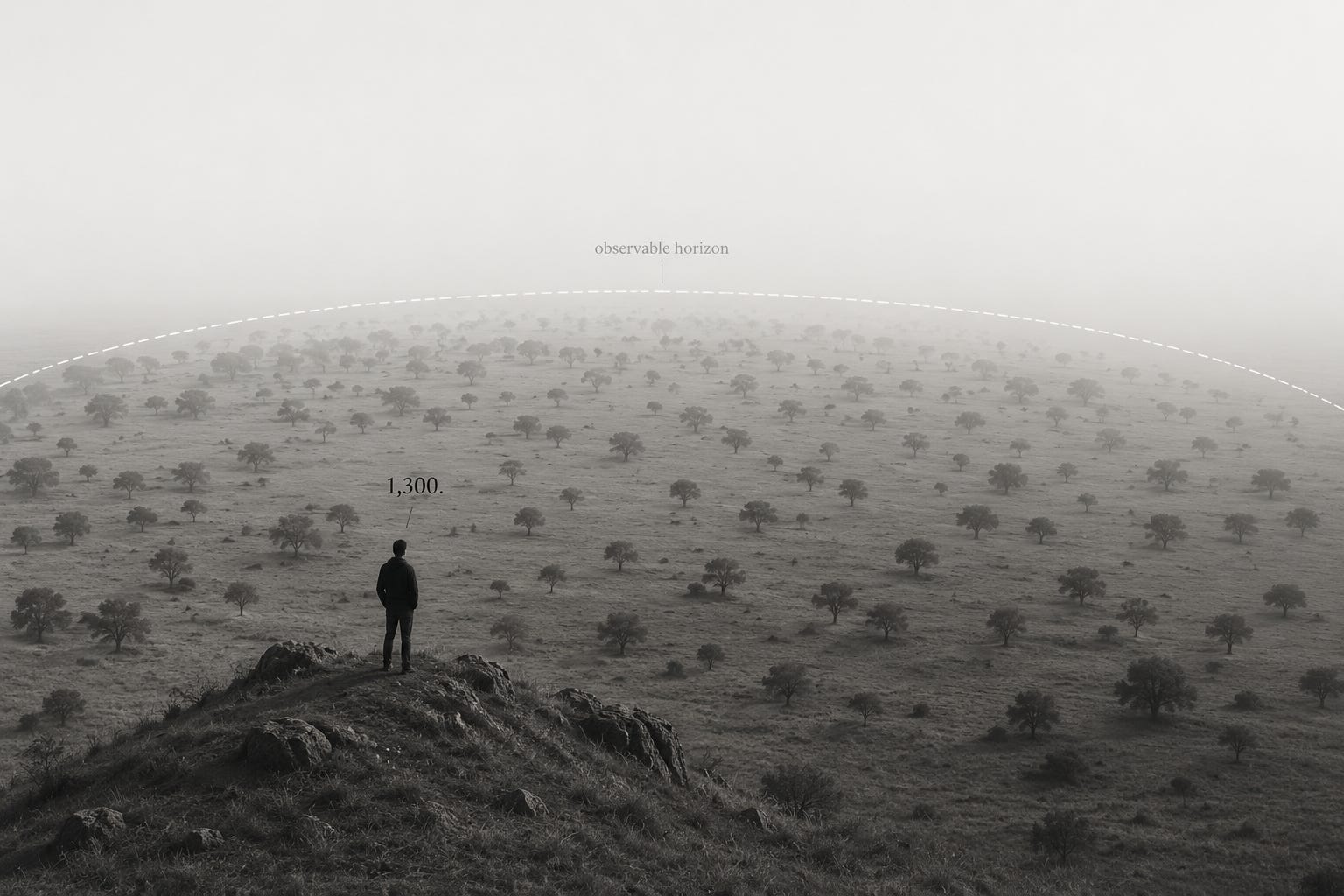
Imagine climbing a hill, counting 1,300 visible trees, and solemnly announcing:
“There are 1,300 trees in the observable landscape.”
True!
But who cares?
If you knew Earth’s size, you might use those 1,300 trees to estimate the number of trees on Earth. That would be interesting. But if you had no idea how large Earth was — and didn’t even know whether its area was finite — endlessly marveling at your 1,300 observable trees would be bizarre.
Yet astronomy does this constantly.
And perhaps unsurprisingly, “observable” has a funny habit of disappearing.
~ NASA: “Thanks to Hubble, scientists estimate there are some two trillion galaxies.”
[NASA, 2017: https://svs.gsfc.nasa.gov/12596/]
~ NASA: Hubble observations “suggested there are about two trillion galaxies in the cosmos.” The same article speaks of “90% of the galaxies in the universe.”
[NASA Science, 2021: https://science.nasa.gov/missions/hubble/new-horizons-spacecraft-answers-question-how-dark-is-space/]
~ Oxford astrophysicist Becky Smethurst titled a 2026 video: “How do we know there are 2 TRILLION galaxies in the Universe?”
[Dr. Becky, YouTube, 2026:
~ Anne Marie Helmenstine, Ph.D.: “Scientists estimate there are about 10^80 atoms in the universe.”
[ThoughtCo: https://www.thoughtco.com/number-of-atoms-in-the-universe-603795]
This slippage is understandable — because dropping observable is what makes the number sound interesting.
“There are two trillion galaxies in the universe” sounds like an astonishing fact about the scale of reality.
“There are two trillion galaxies within the distance from which light has happened to reach us by now” sounds rather more like the 1,300 trees.
The latter may be scientifically useful for plenty of purposes. But as a grand statement about how much universe there is, it’s nearly contentless. Without knowing the size of the whole, an enormous count inside our observational horizon tells us essentially nothing about the total.
There could be trillions of galaxies in the universe.
Or vastly more.
Or infinitely many.
We don’t know.
Which may be at least part of the reason “observable” so often gets lost on the journey from the technical qualification to the awe-inspiring headline.
The accurate version is much harder to marvel at.
Said succinctly:
Knowing the number of trees on our planet is carving nature at its joints. Also for how many on a continent or island. But NOT for how many I can see from my hilltop.
Similarly, knowing the number of galaxies in the universe is carving nature at its joints. Also for how many stars in our galaxy, or how much mass in our solar system. But NOT for how many galaxies we can observe from Earth.
Astrophysicist can estimate the number of nonvisible galaxies by, among other ways, measuring the rate of expansion and calculating how much universal mass is required to explain that rate. The larger challenge is estimating what percentage of the universe’s mass is dark matter.