


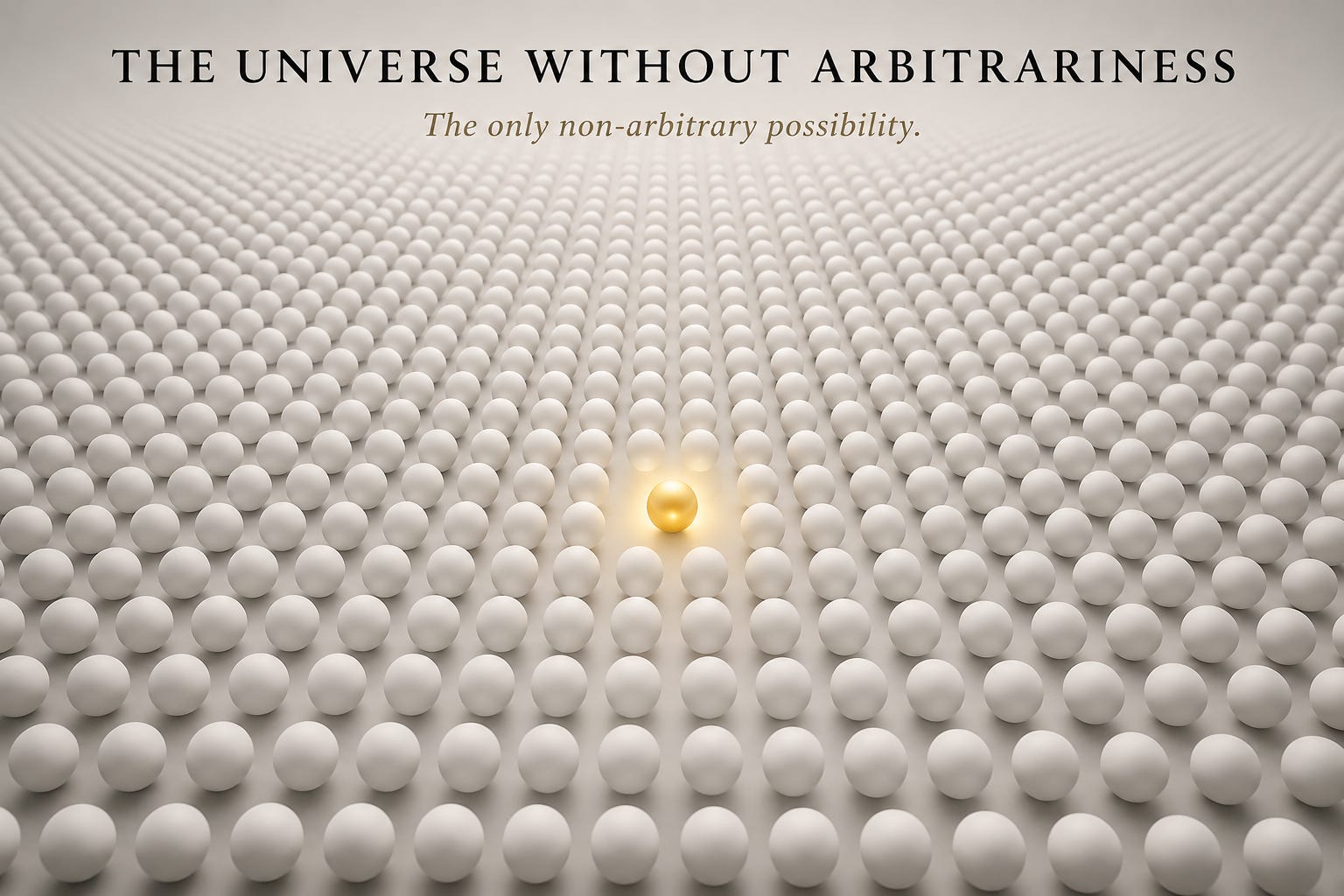
The Universe Without Arbitrariness
One of the deepest aspirations in science is not merely to explain things, but to explain them from as little as possible.
Usually, this means grounding some important phenomenon in more fundamental premises. If those premises seem reasonable—or at least probably true—then the theory has done its job. It is not necessarily the theory’s problem to explain why those premises themselves hold. Newton could explain Kepler’s laws of planetary motion from deeper laws of motion and gravity. That was already a monumental achievement, even if Newton’s own laws were left standing as axioms.
Physics is filled with triumphs of this kind. Peculiar, apparently unrelated phenomena turn out to follow from a small number of deeper principles. Planetary orbits follow from gravitation. Light, electricity, and magnetism become aspects of one electromagnetic framework. Vast domains of the world that once seemed disconnected collapse into a compact mathematical structure.
Even more satisfying are those cases in which a phenomenon seems to emerge from almost nothing at all—from mathematics applied to a more basic description. Thermodynamics once appeared to require its own fundamental laws. Much of it can now be understood through statistical mechanics. Temperature, entropy, and the familiar directionality of macroscopic processes arise from the combinatorics of enormous numbers of microscopic states. In an important sense, the higher-level regularities are not extra ingredients. They are what almost inevitably happen.
That is what one would ideally like to do for the whole universe.
One would love to discover that Lorentz invariance, general relativity, quantum mechanics, and even the peculiar (U(1)\times SU(2)\times SU(3)) symmetry structure of the Standard Model simply had to be that way. The fundamental laws would not be substantive facts about our particular universe. They would fall out of mathematics itself. Reality would have no room to be otherwise.
But it increasingly does not look as though this hope will pan out.
Whatever final unified laws physicists eventually reach are unlikely to be nothing but mathematics. They will probably contain substantive structure: particular symmetries, particular fields, particular constants, particular rules. They may be extraordinarily elegant and extraordinarily deep, but they will still seem to describe one way a universe could be organized among other conceivable ways.
Many physicists claim not to care. The universe is what it is. There is no teleology in physics. Reality does not owe us an explanation that makes its laws inevitable.
And perhaps the demand itself is incoherent. There is no such thing as an axiom that justifies itself. Once one reaches the bottom, what could possibly lie beneath it?
Yet anything short of that leaves us destined to have no answer to the child who asks, after all the equations have been written down and all the forces unified,
“Yeah, but why is the universe set up that way?”
If the answer is simply, “Those are the laws,” then centuries of physics may have relocated the mystery without dissolving it.
This longing has a long philosophical pedigree. It is closely related to the Principle of Sufficient Reason: the intuition that there ought to be some reason why reality is this way rather than another. Whether or not one accepts the principle in its strongest form, it captures something fundamental about explanation itself. We do not merely want to know what the facts are. We want to know why those facts obtain rather than others.
I do not have an answer to this dilemma. But there is a remarkably similar problem in another foundational area: the Problem of Induction.
Why are we justified in believing some things rather than others?
The trouble is that what one ought to believe is never uniquely determined by the evidence alone. Suppose thousands of observed points lie perfectly on an upward-sloping straight line. The natural conclusion is that the underlying function is that straight line.
But infinitely many curving functions could pass through every one of those points. None would contradict any observation made so far.
The evidence therefore never uniquely determines the “smart” hypothesis.
What one concludes depends, in a nutshell, on one’s prior.
If you and I begin with similar priors, then after seeing the same observations we will probably agree that the straight line is overwhelmingly more plausible than the fantastically contorted alternatives.
But a prior is what one believes before the evidence. At the ultimate limit, it is the probability assigned to every possible hypothesis before having learned anything at all about the world.
How could that possibly be justified?
By definition, the prior was not obtained by checking reality. You and I could begin with arbitrarily different priors, encounter exactly the same data, and end up believing radically different things.
The similarity to physics is striking. We are unsatisfied if the character of the universe rests on peculiar laws for which no explanation is possible. And we are equally unsatisfied if everything we are justified in believing ultimately rests on peculiar probabilities assigned before any evidence was available. In both cases, the explanatory chain appears to terminate in pure presumption.
Thirty years ago, Tim Barber and I proposed what we came to call the Paradigm Theory of Induction. The basic idea was to go one level below the prior.
What lies beneath a prior need not be another probability assignment. It can instead be a conceptual framework—a paradigm.
Before one has any data about which hypotheses are probable, one can still notice properties and relations among hypotheses. One may notice that some functions are simpler than others. One may distinguish polynomials from non-polynomials, smooth curves from discontinuous ones, low-degree expressions from high-degree ones, or hypotheses possessing one symmetry rather than another. None of this yet favors any hypothesis. The paradigm merely notices.
But noticing some distinctions inevitably means failing to notice others. Every conceptual framework has limited resolution. It may distinguish one broad family of hypotheses from another while leaving many hypotheses within each family indistinguishable.
The result is a collection of hypothesis clumps. The hypotheses inside a clump are genuinely different, but not as far as the paradigm is concerned. The conceptual framework has no resources for expressing their differences.
Once those clumps exist, two simple rationality principles do almost all the remaining work. Each clump should receive equal probability in the absence of any recognized reason to favor one over another. And within each clump, each hypothesis should receive equal probability, because the paradigm cannot articulate a distinction among them that would justify unequal treatment.
This is simply Laplace’s Principle of Indifference applied at two levels.
The prior then follows from the paradigm.
The foundation still has no empirical foundation. It cannot. But it is no longer a naked probability assignment. One can instead say,
“I see the space of possibilities like this.”
And that alone is enough to determine the empirical assumptions implicitly being made.
Have we merely pushed the arbitrariness down one level?
Not quite.
We possess genuine intuitions about sensible and nonsensible ways to carve a space at its joints. A paradigm can be natural, mathematically motivated, and structurally simple—or it can be an ill-gerrymandered, grue-like construction designed solely to force a predetermined conclusion.
As Tim and I showed, so long as the paradigm is not pathological in this way, different reasonable paradigms tend to generate similar priors. There simply is not enough freedom in ordinary ways of conceptualizing hypotheses to justify arbitrary empirical commitments.
Someone can still ask, “What justified you in conceptualizing the hypotheses that way?”
The answer is not that the paradigm itself was empirically verified. It is that nearby, non-gerrymandered paradigms tend to lead to essentially the same place. To obtain radically different priors, one must begin conceptualizing hypotheses in ways that no mathematician would regard as natural.
We had done something that initially seemed impossible: provided a kind of conceptual justification for an empirical foundation.
Now return to physics.
Suppose there exists a space of possible universes—or equivalently, a space of possible fundamental laws. Suppose further that there exists a natural way of conceptualizing that space: a kind of physics paradigm. Like the paradigms in induction, it notices properties and relationships among possibilities, but not every conceivable distinction.
The possible universes are thereby partitioned into symmetry classes.
Imagine there are only five possible universes.
Under the natural conceptualization, one universe stands entirely alone, while the other four are symmetric with one another. As far as the paradigm is concerned, there is nothing principled that distinguishes any member of that four-element class.
Now suppose the singleton universe is the actual one.
That would hardly seem accidental. Had one of the other four been actual, an immediate question would arise: Why that one rather than one of its three indistinguishable companions? Making one member of a perfectly symmetric class actual would require an arbitrary choice.
The singleton universe would require no such choice.
It would be the only universe that could be actual without an arbitrary selection from among equals.
Now imagine infinitely many possible universes instead.
Suppose that under every natural, non-gerrymandered conceptualization, almost every possible universe belongs to some larger symmetry class, while exactly one universe always occupies a singleton class.
If our universe turned out to be that singleton, no one in their right mind would dismiss the fact as a coincidence.
And here is the crucial point: the universe would not be logically necessary. Other universes would remain perfectly conceivable.
What we would have instead is contingency without arbitrariness.
Our universe could have been otherwise in the ordinary modal sense. Yet every alternative would require reality to distinguish arbitrarily among possibilities that, at the deepest natural level of description, have no principled distinction among them. Our universe alone would require no such unexplained symmetry-breaking.
The Principle of Sufficient Reason could therefore be satisfied in a subtler way than philosophers have usually imagined.
The sufficient reason would not be that every other universe was impossible.
It would be that every other universe required an arbitrary selection from among conceptual equals, whereas this universe alone did not.
Perhaps, then, the deepest laws of physics need not be derivable from nothing in the strict sense. Perhaps they need not be unavoidable theorems of pure mathematics, nor self-justifying axioms.
They need only pick out the one universe that requires no arbitrary choice.
Perhaps the final laws of physics will define a universe occupying a unique position under every natural way of carving the space of possible universes. The alternatives would remain mathematically conceivable, but only as members of symmetry classes whose internal differences possess no principled significance. For any one of them to be actual would require reality to break symmetry for no reason at all.
Our universe would be different.
The universe need not be the only possible universe. It need only be the only non-arbitrary one.
—
Our Paradigm Theory:
https://www.changizi.com/uploads/8/3/4/4/83445868/changizibrain25000chapter3.pdf