


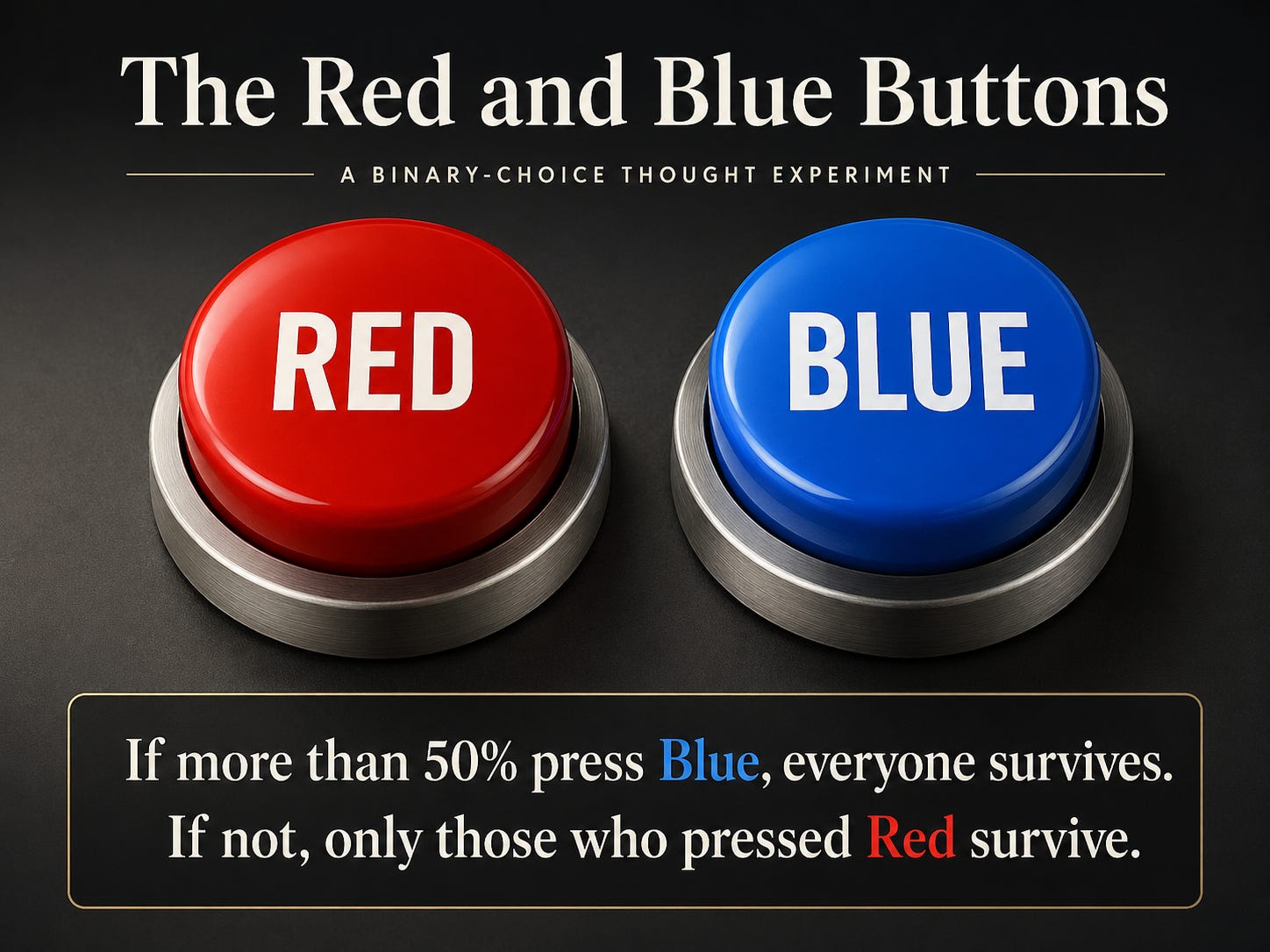
In a simple thought experiment popularized by Tim Urban, participants face a binary choice: press the Red button or the Blue button.
The rule is straightforward: if more than 50 percent press Blue, everyone survives. If not, only those who pressed Red survive.
Logically, the rational choice is obvious: press Red. Your survival is guaranteed regardless of what others do. There is no downside to your individual action, no one is harmed by it, and your outcome is optimal without any need for coordination.
Yet astonishing numbers of people choose Blue. They opt for a path that requires fragile mass cooperation, risking everything on the hope that enough others will join them in a collective gamble.
This is not an isolated curiosity. The same flawed reasoning appears in two sharpened variants.
Imagine a flood. Each person has a personal life preserver. Keeping your own life preserver — Red — means surviving independently. Donating it — Blue — means contributing to a collective effort to build one large boat. But the boat can only be completed, and save its contributors, if more than 50 percent donate. If the threshold is not met, those who donated drown.
Or consider the Suicide Button. You receive a strange spam email with a button labeled “Suicide.” Pressing it means you’ll be dead by midnight — only press it if that’s what you want. Fine print: unless more than 50 percent also press it, in which case the button’s functionality fails.
There isn’t even a Red button. Red is simply ignoring the stupid spam email that introduced you to the Suicide Button and continuing with your life.
In all these cases, the decentralized, self-interested choice — Red, or non-participation — is unambiguously superior. Cooperation — Blue — brings no inherent benefit over individual action. It merely introduces the risk of catastrophic failure if buy-in falls short.
These variants expose a deeper truth: what appears to be a “dilemma” is not one at all in the classic sense of the Prisoner’s Dilemma. There is no holistic downside to self-interested action. Each Red choice is positive-sum in its own sphere — consensual where it interacts with others, beneficial to the actor, and imposing no costs.
Cooperation has no intrinsic advantage. At best, it approximates the baseline outcome of decentralized self-interest. Far more often, it delivers something worse. The entire setup only becomes a dilemma because of human irrationality — an instinctive pull toward the illusion of moral cooperation, even when the math and incentives scream otherwise.
And this fragility cannot be overcome by zeal. Even seeming near-universal buy-in leaves the collective gamble vulnerable. The slightest shortfall turns it into collective disaster.
This button logic maps directly onto the perennial debate between freedom and collectivism. Decentralized mechanisms — free markets, voluntary exchange, the marketplace of ideas — are the Red button. Or, in the Suicide Button variant, the decision to delete the spam and get on with life.
Logic, economics, and empirical history demonstrate that these decentralized systems are vastly superior at generating wealth, discovering truth, and sustaining functional societies. When individuals act on their own incentives, their interactions are consensual and positive-sum: both parties benefit, and no one is coerced into the scheme. There is no need for top-down coordination, central planning, or enforced narratives. Emergent order arises naturally from billions of localized decisions, producing complexity and prosperity no designer could orchestrate.
Collectivism, by contrast, is the Blue button.
It demands mass buy-in for a centralized vision — whether economic planning, enforced equality, or ideological conformity. Cooperation is not optional. It is the prerequisite for the system to function at all.
And like the Blue button, it is inherently fragile. It delivers, at best, something close to the decentralized baseline — and usually far worse. It requires reaching some critical threshold of genuine zeal — much like the 50 percent threshold in the button experiments — to avoid collapse. Below that threshold, the results are predictable and grim: poverty, famine, institutional failure.
Worse still, when the percentage of true believers dips, regimes frequently resort to coercion, propaganda, or outright democide to manufacture the appearance of support. The great crimes against humanity of the last century were not random aberrations. They were the predictable consequences of fragile collective mechanisms that could not tolerate insufficient buy-in.
The freedom-versus-collectivism debate is far more difficult for people to reason through than even the simple Red/Blue button scenario. The button setup is stripped bare: binary, immediate, life-or-death stakes, transparent rules.
Free markets and emergent order require grasping complex systems, spontaneous order, price signals, and the unseen consequences of intervention — concepts that are abstract and counter-intuitive. If humans routinely fail the button test, succumbing to the siren song of cooperation despite its obvious fragility, how much more intractable is the task of persuading them that decentralized freedom is not merely morally permissible, but practically superior?
The button experiment, in a nutshell, explains why collectivism will forever be with us. It is not that the evidence is lacking. It is that the cognitive flaw runs deeper than evidence can reach.
Ultimately, the Red versus Blue variants — whether the original poll, the life-preserver flood, or the Suicide Button — stand as powerful parables of the sickness of the human condition. They reveal a persistent, almost primal inability to trust individual reason and self-interest over the emotional pull of collective sacrifice.
This sickness ensures that collectivism, with all its fragility and catastrophic potential, will continue to haunt humanity. No matter how often decentralized systems demonstrate their superiority in raising living standards, uncovering truth, and enabling peaceful cooperation, the Blue temptation remains.
We press it again and again, betting the future on the hope that this time, enough others will join us before the boat sinks or the threshold fails.
The parable does not flatter us. It warns that this cognitive affliction is not a bug we will soon debug, but a feature of our nature — one that will shape history’s tragic cycles for as long as we remain recognizably human.