


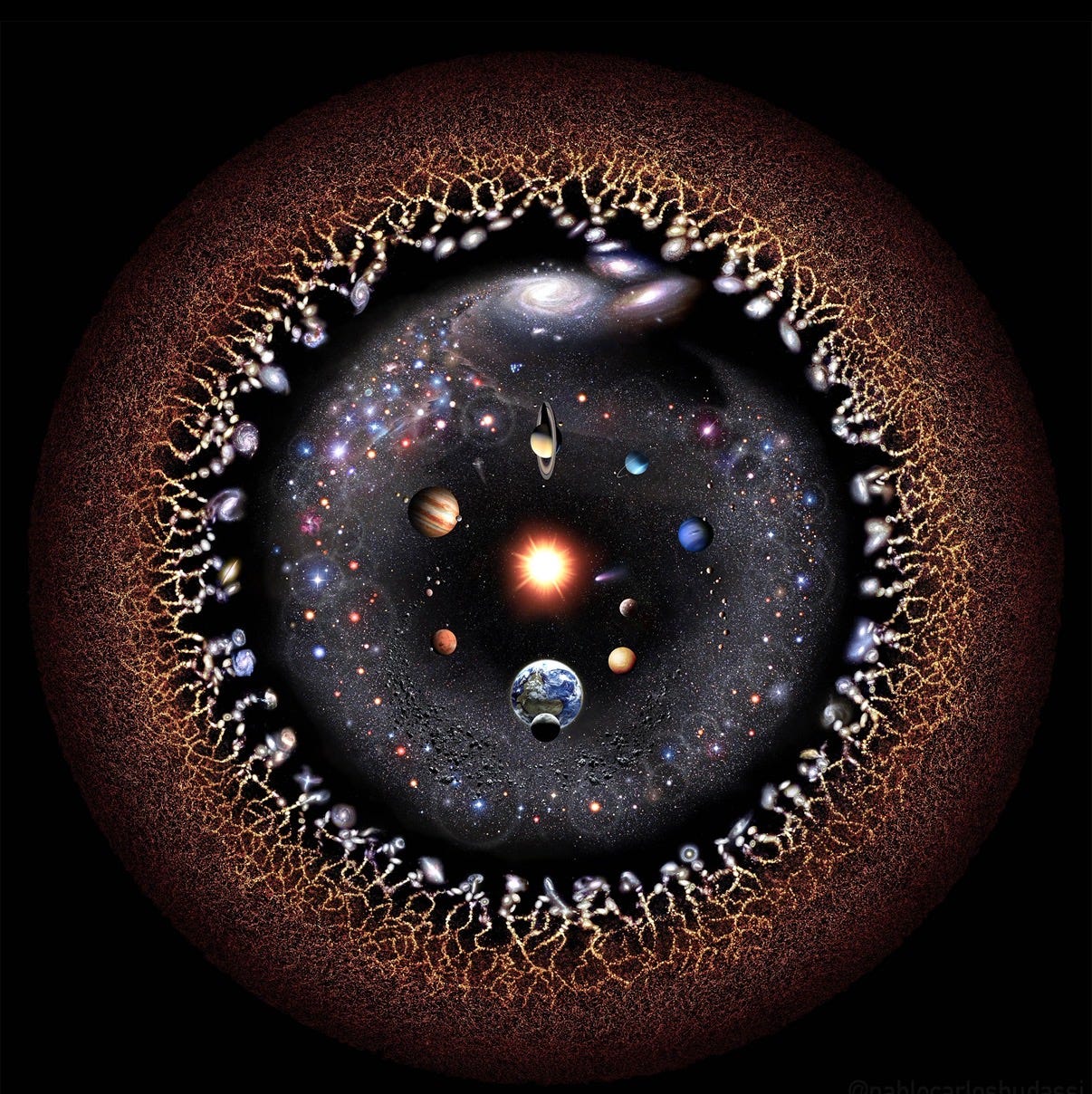
Imagine a civilization confined to a small island.
They have no way to leave. They can’t communicate with anyone beyond it. But they know their island is a tiny speck on an enormous planet, with continents stretching unimaginably far beyond anything they can see.
One day, someone asks the island’s scientist:
“How many trees are there in all the world?”
“I’ll look into it.”
A few weeks later he returns.
“About 1,300.”
“Wait. There are only 1,300 trees in the entire world?”
“Well, no. I climbed the tallest hill on the island and counted all the trees I could see. About 1,300.”
“Uh.”
“Hundreds and hundreds of trees,” he intones gravely.
Nobody would talk this way.
In fact, the more seriously the scientist presented his number, the more asinine it would become.
Imagine generations of island scientists refining it. Better telescopes. Better surveys. Papers announcing that the previous estimate of 1,300 visible trees was too low: there are actually closer to 1,700. Popular science books marveling at the staggering number of trees “in the world.” Teachers telling children that the world contains hundreds and hundreds of trees.
Occasionally, someone carefully adds the qualifier: trees observable from our island.
But that almost makes it worse.
Who cares?
The scientists already know their island is a negligible fraction of the planet. They know perfectly well that the boundary of what they can see has nothing whatsoever to do with the boundary of the world. Why would anyone elevate the number of trees visible from this particular hill, on this particular island, into one of the great quantitative facts about nature?
And yet astronomy has been doing something remarkably similar for nearly a century.
How many atoms are there in the universe? Roughly 10^{80}.
How many galaxies? Hundreds of billions, perhaps trillions.
Except, of course, these aren’t counts of the universe. They’re estimates for the observable universe: the patch from which light has had enough time to reach us.
Our cosmic hilltop.
Astronomers know perfectly well that this horizon is not known to be the edge of the universe. The universe may extend vastly beyond it. It may be enormously larger than the part we can observe. It may be infinite.
Which means that when someone asks, “How many atoms are there in the universe?” the remarkable scientific answer isn’t 10^{80}.
It’s we have no idea.
The 10^{80} number is just how many atoms we estimate are beneath our particular cosmic lamppost.
Somehow, that parochial number became one of the most famous numbers in science.