


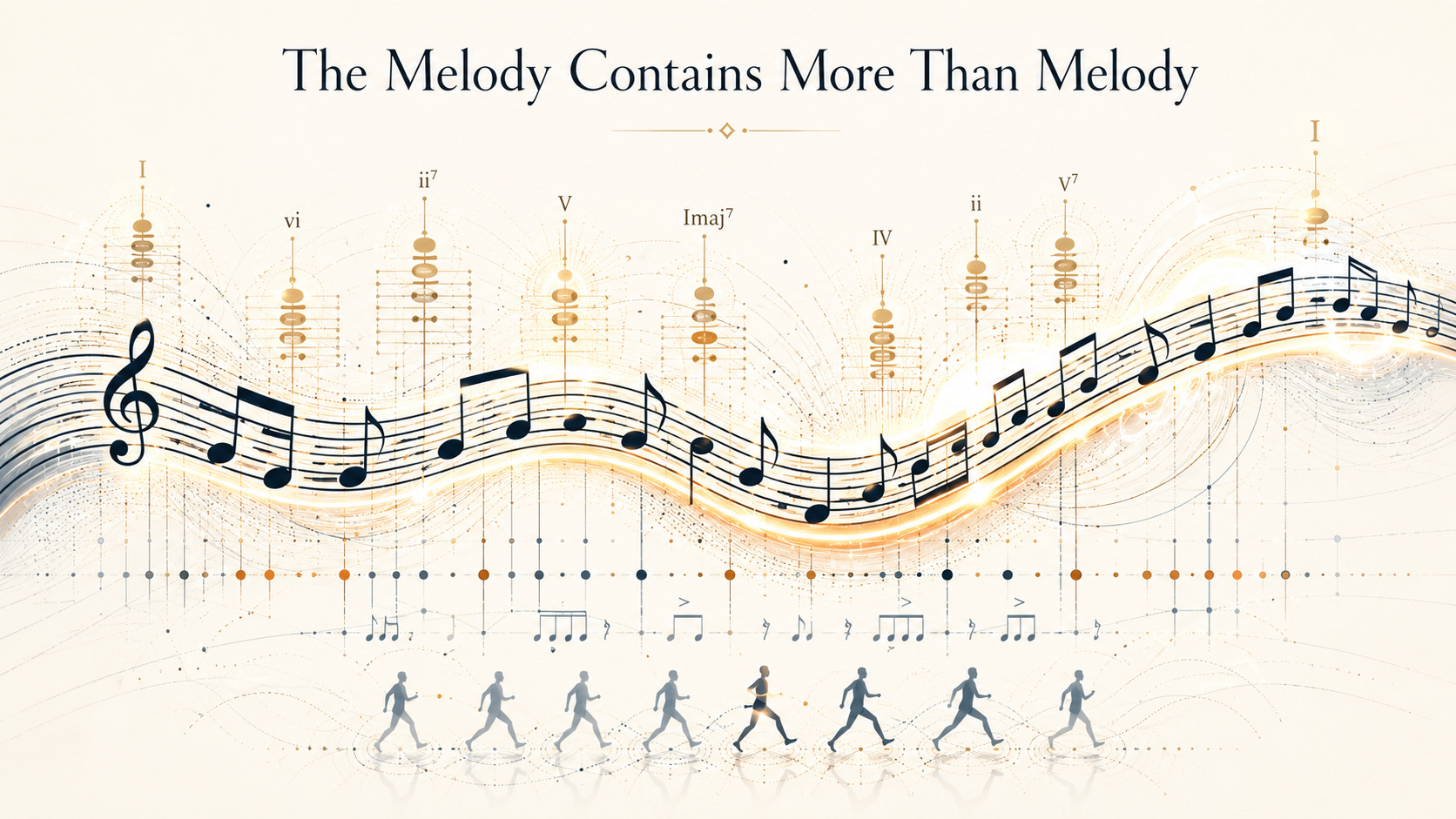
One of the most obvious things in music is something we almost never bother to point out.
The rhythm section almost never follows the melody’s exact rhythm.
Drums and groove usually do not trace the melody note for note, accent for accent, pause for pause. They hold down the larger bodily scaffold — the pulse, gait, meter, recurring support pattern. The melody rides on that scaffold, using its own much more specific timing pattern.
That by itself is ordinary enough. But place it next to a better-known fact and something very strange appears.
Everybody knows that harmony constrains melody, but does not uniquely determine it. A chord progression does not tell you what the melody has to be. There are many melodies that could live over the same chords.
But the reverse is much less symmetrical: melody often strongly implies the harmony. Hear the melody alone and you can often tell, with surprising confidence, what the chord progression must be.
Now notice the same asymmetry in time. The underlying rhythm constrains the melody’s rhythm, but does not uniquely determine it. The beat and groove do not tell you what exact timing pattern the melody must use.
But again the reverse is much less symmetrical: the melody’s rhythm often strongly implies the song’s underlying rhythm. Even without percussion, the melody usually gives away the pulse, the meter, the gait-level organization underneath.
So melody is doing something remarkable. It is not merely one line floating on top of harmony and rhythm. It somehow carries a great deal of both inside itself.
The melody usually points strongly to:
~ a specific chord progression
~ a specific rhythmic scaffold
And neither of those, taken by itself, points back to one equally specific melody.
That is an asymmetry worth staring at.
It tells us that melody is extraordinarily information-rich. It compresses into one stream things that seem, at first glance, to belong to different musical “layers.” The melody somehow contains clues about the harmonic world beneath it and the bodily pulse beneath it, while still remaining its own distinct thing.
How does it do that?
For me, as an evolutionary theorist, that immediately raises the deeper question: what must melody, chord progression, and rhythm be conveying, such that one of them can carry so much of the others inside itself?
My 2011 book Harnessed made a book-length case that music culturally evolved to sound like a person moving evocatively in your midst. My newer work extends that framework to tonal music itself — the familiar diatonic scale, chords, chord progressions, and melody over them.
The hint is this:
it’s all about conveying the manner in which a nearby person is moving.
Rhythm gives the bodily gait-level scaffold. Chord progressions give the changing rigid-body relation. Melody gives the expressive moving line riding on top of it. That is why melody can imply so much. It is not just another layer. It is the compressed signature of the whole moving organism.