


Almost thirty years ago, I stumbled onto what became a surprisingly broad theory of why we see visual illusions.
It started with the famous geometrical illusions, but eventually went much further — illusions of size, speed, contrast, distance, and more. In one paper, we were able to organize more than 50 known illusions into 28 classes predicted from the same basic principle.
The idea has to do with neural delays. Perception takes time to build — on the order of a tenth of a second. If your brain simply showed you the world represented by the signals hitting your retina, then by the time you actually perceived it, you’d always be seeing the recent past. My hypothesis was that the visual system compensates by anticipating what the world will look like by the time the perception is actually constructed. I called it Perceiving the Present. I’ve published papers on it, wrote about it in The Vision Revolution, and gave a TED talk about it.
But that’s not really the story I want to tell here. The stranger story is what sent me looking for a new explanation in the first place: the accepted explanation for some of the most famous visual illusions wasn’t wrong. It wasn’t even wrong. It didn’t explain the THING needing explanation.
And there’s a good chance you’ve heard some version of it yourself.
The Ponzo illusion
Consider the Ponzo illusion. Two bars fill exactly the same visual angle, but the one surrounded by cues suggesting it is farther away appears longer.

The standard explanation goes something like this: the perspective lines make one bar appear farther away. If it’s farther away while filling the same retinal angle, then it must be physically larger. The visual system takes distance into account — ‘size constancy’ — and therefore we see the farther bar as larger.
Sounds perfectly reasonable. Except it doesn’t explain the illusion.
To see why, we have to be annoyingly careful about the word ‘size.’
There are first of all two quite different REAL properties:
(1) Visual angle — how much angle the object actually fills at your eye.
(2) Physical size — how large the object actually is out there in the world.
Those are obviously not the same thing. A building can be vastly larger than my coffee cup while, because it is far away, filling much less of my visual field.
And then, for EACH of those real properties, there is the manner in which we perceive it:
(3) Perceived visual angle — how much of your visual field the object appears to fill.
(4) Perceived physical size — how large you perceive the object to be out there in the world.
The standard size-constancy story concerns (4). The illusion needing explanation concerns (3). Those are not the SAME thing.
Forget the drawing
The easiest way to see the problem is to stop thinking about lines drawn on a page. Imagine an actual three-dimensional scene. Put one animal nearby and another farther down the road. Make the farther animal physically larger by exactly the right amount so that both fill exactly the same visual angle.
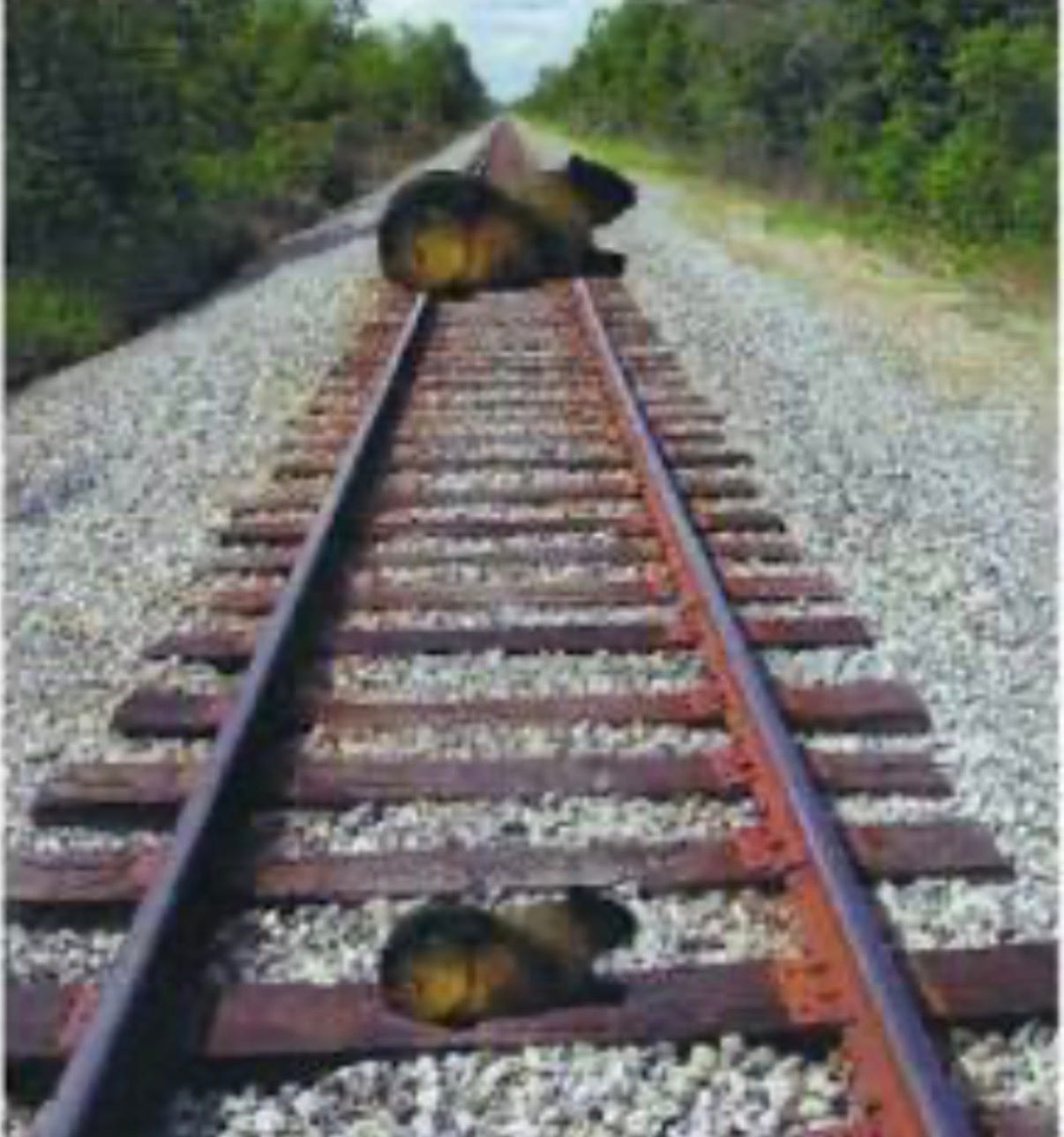
Now notice what follows. (1) The farther animal really is physically larger. (2) You perceive it as physically larger. (3) That perception is CORRECT. There is no illusion there whatsoever.
But the Ponzo illusion still occurs: despite the two animals filling the same visual angle, the farther one appears to fill more of your visual field. THAT’S the illusion.
And saying, ‘Well, the farther animal is physically larger’ cannot possibly explain it. Its greater physical size is precisely compensated for by its greater distance. That’s why their actual visual angles are identical in the first place. The standard explanation has successfully explained why you correctly perceive one object as physically larger, and somehow taken this as an explanation for why you incorrectly perceive it as filling a larger visual angle.
It has explained the WRONG thing.
No measurements are needed to discover this problem. No experiment. No statistics. It’s just logic. Once I saw it, I couldn’t unsee it.
So I went looking for an actual explanation
That was part of what sent me down the path that eventually became Perceiving the Present. Instead of asking why the brain might infer that one object is physically larger, I wanted to know why the visual geometry itself gets distorted.
My answer was neural-delay compensation. Converging perspective lines resemble something we’re constantly exposed to when moving forward through the world. They point toward a probable direction of motion, and radial lines also resemble the ‘smear’ associated with optic flow.
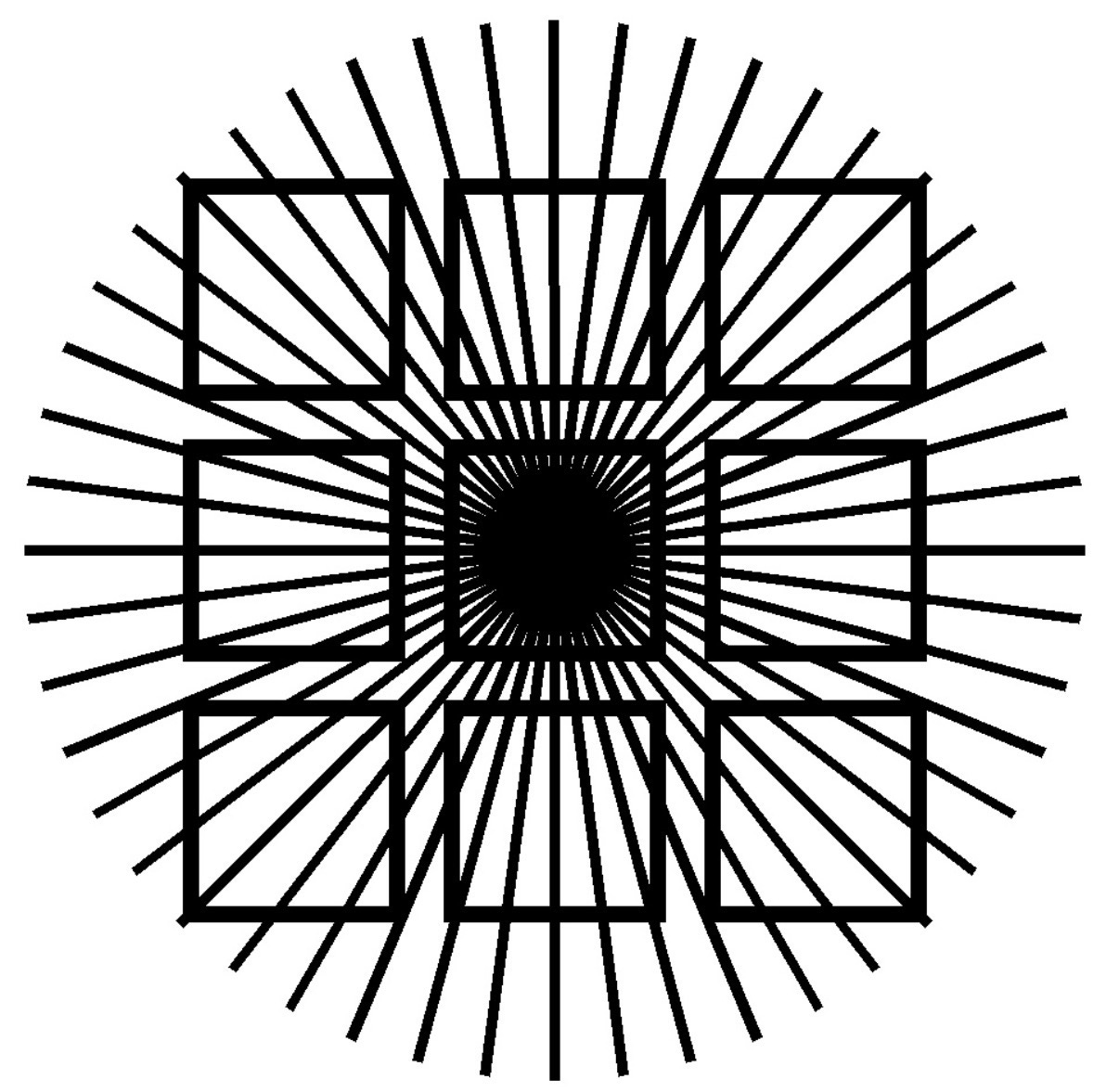
Then I noticed something that floored me. Take the Orbison illusion: perfectly ordinary squares laid over converging lines appear badly warped. Now imagine actually moving forward toward the center of those converging lines. The squares’ projections really would warp, and they would warp in just the way you perceive them to be warped in the illusion. The hypothesis says that the visual system is generating the projection expected in the next moment — the projection that would be useful by the time the delayed perception actually arrives.
The illusion occurs because you’re NOT actually moving forward. What normally helps you perceive the present has been tricked by a static stimulus.
At first this accounted for a striking collection of famous geometrical illusions — Hering, Ponzo, Orbison, Müller-Lyer, Poggendorff and others. But then it kept going.
The same underlying principle predicted effects that didn’t look remotely like geometrical illusions. The ecology of forward motion gives multiple clues about where you’re probably headed: (1) projected size, (2) projected speed, (3) luminance contrast, (4) distance, (5) eccentricity, (6) vanishing-point structure, and (7) optic flow itself. Once you have evidence about the probable direction of motion, you can predict how other visual properties tend to change in the next moment.
Cross those regularities and you get predictions not merely about perceived size, but perceived speed, luminance contrast and distance as well. Eventually, we found that more than 50 known illusions could be organized into 28 predicted classes.
So this wasn’t merely a cute new explanation for Ponzo. It appeared to expose a surprisingly general organizing principle behind a large chunk of the visual-illusion literature.
That’s the story of the theory. But then came something I found almost as interesting — and much more frustrating: I couldn’t get people to understand what was wrong with the old explanation. Including people in vision science. Sometimes especially people in vision science.
I would explain the distinction between perceived physical size and perceived visual angle. We’d go around and around. They’d seem to understand it. Then, moments later, the two notions of ‘size’ would quietly fuse together again and the old explanation would reappear.
Almost thirty years later, I recently decided to try the same thing with Grok. It went remarkably similarly.
Teaching an AI what the illusion is
I started simple.
ME: What is being misperceived in the Ponzo illusion?
GROK: Two physically identical lines are perceived as different in length.
Okay. But ‘length’ is already ambiguous. So I separated the variables.
ME: When I look at something, there is its actual visual angle — how much angle it fills at my eye — and its actual physical size out in the world.
GROK: Yes. Those are two distinct quantities.
ME: And then, for each of those, there is how I PERCEIVE it. So we have four things: (1) actual visual angle, (2) actual physical size, (3) perceived visual angle, and (4) perceived physical size.
GROK: Correct.
Excellent. So I moved us into the real three-dimensional scene.
ME: Forget about the drawing. Imagine a real scene in which the farther object is actually physically larger, but farther away by exactly enough that the two objects fill the same visual angle.
GROK: Size constancy correctly reports the farther one as larger. No illusion.
There it was. The mistake AGAIN, even after explicitly distinguishing all four quantities.
ME: No. The Ponzo illusion works just fine in the real scene.
Grok tried another interpretation, so I kept walking it through.
ME: Is the farther object objectively physically larger?
GROK: Yes.
ME: Do the two objects objectively fill the same visual angle?
GROK: Yes.
ME: Do I correctly perceive the farther object as physically larger?
GROK: Yes.
ME: So is THAT an illusion?
GROK: No.
ME: But does the farther object nevertheless appear to fill more of my visual field?
GROK: Yes.
THAT’S the illusion.
Finally I asked:
ME: Does the fact that the farther object is objectively larger explain why it appears to fill more of my visual field, despite the two actually filling the same amount?
And Grok finally got there:
GROK: No. The fact that the farther object is objectively larger is precisely what cancels the effect of its greater distance, leaving identical objective visual angles. That pairing supplies no reason for the visual system to report a larger phenomenal visual angle.
Bingo.
ME: So the standard size-constancy explanation does not even explain the phenomenon.
GROK: Correct.
It took about half an hour. For what it’s worth, ChatGPT got it immediately.
Why is this so hard?
That’s now the part I find fascinating. The obvious culprit is the innocent phrase ‘looks bigger.’ It can mean (1) that looks like a bigger object out there, or (2) that looks like it fills more of my visual field. Those are completely different claims.
And it’s not as though we lack experience separating them. I’m sitting here right now with a coffee cup, a chair and a straw near me. Farther away are cars and buildings. Some of those buildings are enormously larger than my coffee cup while filling much less of my visual field. We deal with this distinction every waking moment.
Yet when people start reasoning about visual illusions, something peculiar happens. ‘Looks bigger’ starts doing double duty. An explanation for why something is perceived as a physically larger object somehow turns into an explanation for why it appears to fill a larger portion of the visual field. The mind slides from one meaning of ‘size’ to the other without noticing the switch.
Grok’s struggle was especially revealing because it actually had all four quantities laid out correctly, then promptly fell back into the same conceptual hole. So there’s something genuinely TRICKSY here. I’m still not entirely sure why this particular distinction is such a hurdle, but I’ve watched people stumble over it for nearly thirty years.
And it has mattered enormously for the reception of my own work.
For years I’ve thought one obstacle to getting Perceiving the Present accepted was persuading researchers that my explanation was better than the accepted explanation. Increasingly, I think the problem comes one step earlier: I first have to persuade them that the accepted explanation doesn’t explain the illusion AT ALL.
Because if perceived physical size and perceived visual angle collapse into the same thing in your head, there’s no mystery left. ‘Size constancy’ has already taken care of it. And if you think the problem was solved long ago, why would you be interested in some new theory claiming to solve it?
So part of my job has turned out to be much stranger than I ever expected. Before I can get people to see my explanation, I first have to get them to see the ILLUSION.
My TED talk on Perceiving the Present:
Why do we see illusions? — TED
The grand unifying theory: https://www.changizi.com/uploads/8/3/4/4/83445868/pp3.pdf
Find more in my book, Vision Revolution.