


Maybe Americans are not stupid for liking Fahrenheit.
Maybe feet, inches, pounds, cups, and miles are not just embarrassing relics from the pre-scientific past.
Maybe they are fossils of something smarter: a measurement system shaped by bodies, hands, kitchens, fields, weather, roads, and ordinary human life.
Metric is magnificent. No serious person should deny that. It is clean, decimal, universal, and ideal for science, engineering, medicine, manufacturing, and calculation across scales. If you are building a bridge, mixing chemicals, or sending a probe to Mars, use metric.
But if you are asking how tall a person is, how hot the day feels, how far the store is, how much flour to add, how big the room is, how much a package weighs, or whether a board is easy to cut into halves, thirds, or quarters, the old system starts to look less idiotic.
It starts to look human.
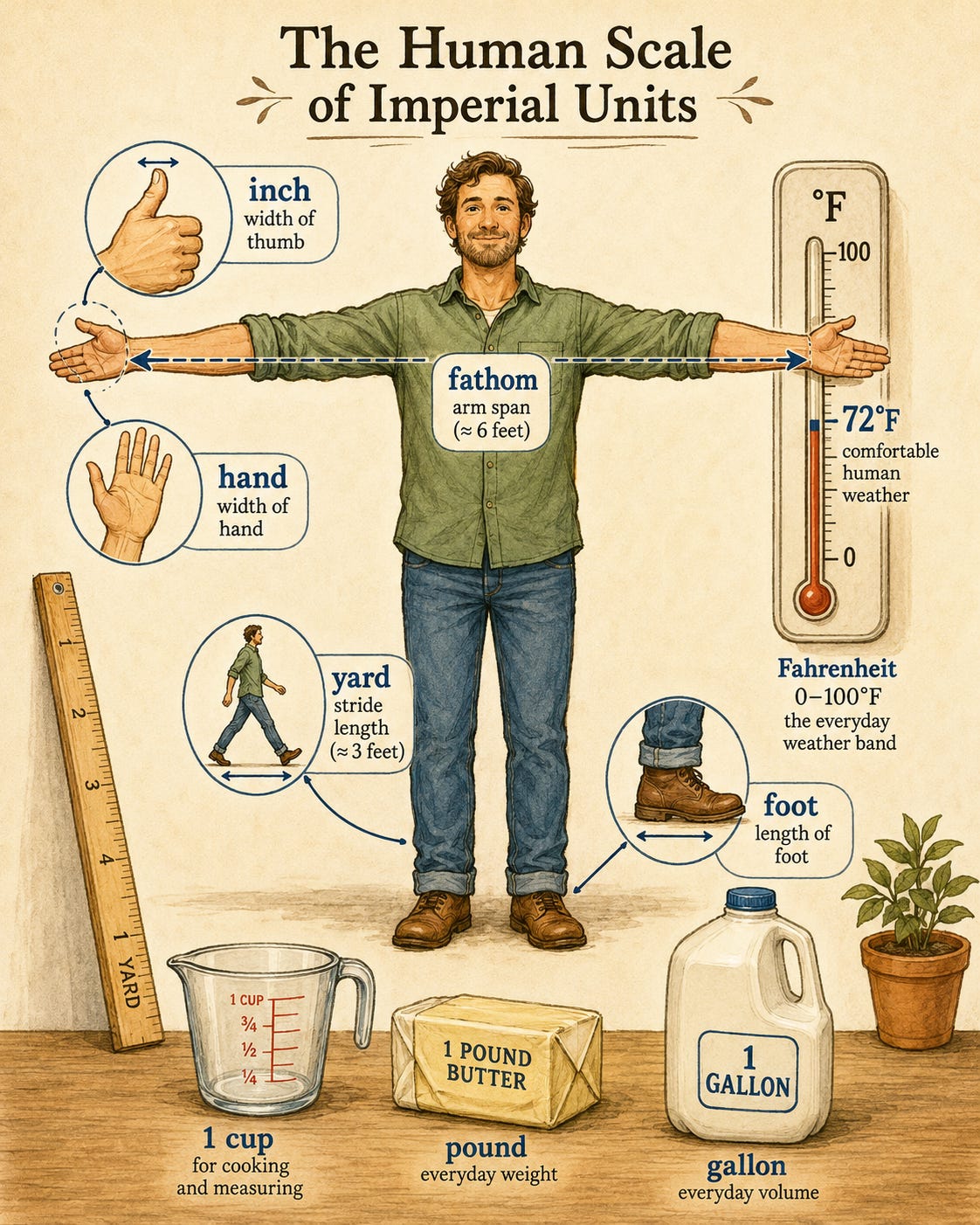
An inch is roughly a thumb-width. A foot is, of course, roughly a foot. A yard is close to a long step, or a stride-like human distance. A fathom is the span of two outstretched arms. A hand, still used for horses, is a palm-scale unit for an animal one physically approaches and sizes by touch and sight. A mile is not a scientific abstraction. It is a travel-scale distance, large enough to be a journey but small enough to imagine bodily.
These are not perfect correspondences, and one should not over-romanticize their origins. But that is not the point. The point is that many customary units cluster near human extents and human actions. They give us handles at the places where we tend to grasp the world.
Even the “ugly” divisibility of Imperial units becomes less ugly at the human scale. Twelve inches in a foot seems irrational if one’s only criterion is decimal conversion. But twelve is wonderfully divisible: halves, thirds, quarters, and sixths all fall cleanly. Sixteen ounces in a pound gives repeated halving: half-pound, quarter-pound, eighth-pound. In a kitchen, workshop, market, or construction site, dividing by two, three, four, eight, twelve, and sixteen can be more useful than dividing by ten.
Volume shows the same pattern. Teaspoon, tablespoon, cup, pint, quart, gallon: these are not elegant scientific units. But they live near familiar acts and objects. A spoonful. A serving. A cup. A pot. A jug. A household container. They describe how liquids and ingredients appear in domestic life. “Two cups” and “a tablespoon” are not merely measurements. They are gestures.
Weight is subtler, because a pound is not a body part in the way a foot is. But it is still a human-scale unit. A pound is a meaningful hand-held quantity: a small parcel, a lump of food, a market amount, a weight one can easily imagine picking up. An ounce is small enough for ingredients, spices, letters, and portions. A pound is large enough to matter but still small enough to grasp. A stone, where it survives, is a coarse body-weight unit, oddly natural for talking about people in a way that is less falsely precise than saying someone weighs 86.2 kilograms.
Land units, too, often come from work rather than abstraction. An acre is tied to the scale of land that could be worked. A furlong is a furrow-long. These are task-sized units. They did not emerge from someone asking what would make multiplication easiest. They emerged from plowing, walking, carrying, cooking, trading, building, and living.
Temperature may be one of the best examples. Celsius is magnificent if the anchor is water: zero is freezing, one hundred is boiling. That is elegant physics. But Fahrenheit is arguably better tuned to ordinary human weather. In many four-season climates, the lived outdoor world is roughly contained between 0 and 100 degrees Fahrenheit. Zero is bitter cold. One hundred is oppressive heat. In between, the scale reads almost like a human comfort meter: 30s are freezing, 40s chilly, 50s cool, 60s mild, 70s pleasant, 80s warm, 90s hot.
Converted into Celsius, that same familiar weather band becomes something like -18 to 38 degrees. Perfectly usable, of course, but less naturally framed as a bounded human range. Celsius gives us water’s drama. Fahrenheit gives us weather’s drama. Celsius tells you what water is doing. Fahrenheit tells you what the weather is doing to you.
This is the deeper distinction. Metric is optimized for universal conversion. Customary units are often optimized, accidentally and culturally, for local description. Metric asks: How do we make all quantities part of one clean decimal ladder? Customary units evolved as if asking: What are the recurring sizes of human action?
That is why Imperial and customary units can feel stupid in a textbook and yet strangely natural in the kitchen, the workshop, the street, and the body. They are full of historical clutter, yes. But clutter is not always noise. Sometimes clutter is memory. Sometimes it is the residue of countless human encounters with the world.
One way to put this is information-theoretic. A good code is not necessarily the most uniform code. A good code is one that fits the distribution of things it needs to describe. If the world we measured every day were uniformly distributed across powers of ten, metric would be hard to improve upon. But ordinary life is not distributed that way. We measure thumb-width things, foot-length things, stride-length things, room-sized things, cup-sized things, hand-held weights, body weights, walking distances, and weather as felt by skin.
So the real question is not which system is better in the abstract. The real question is: better for what?
Metric is the better scientific code. It is coherent, scalable, and clean. But Imperial and customary units may be a better vernacular code, a patchwork of measures tuned to the scales at which humans actually meet the world.
Different tools for different jobs. Metric for the lab and the blueprint. Something more bodily, irregular, and human for the kitchen, the workshop, and the street.
Great piece, Mark. I'm equally comfortable with both systems but you're correct about the "human dimensions" Never thought of it that way and now I do - the mark of on-point writing. Thanks!