


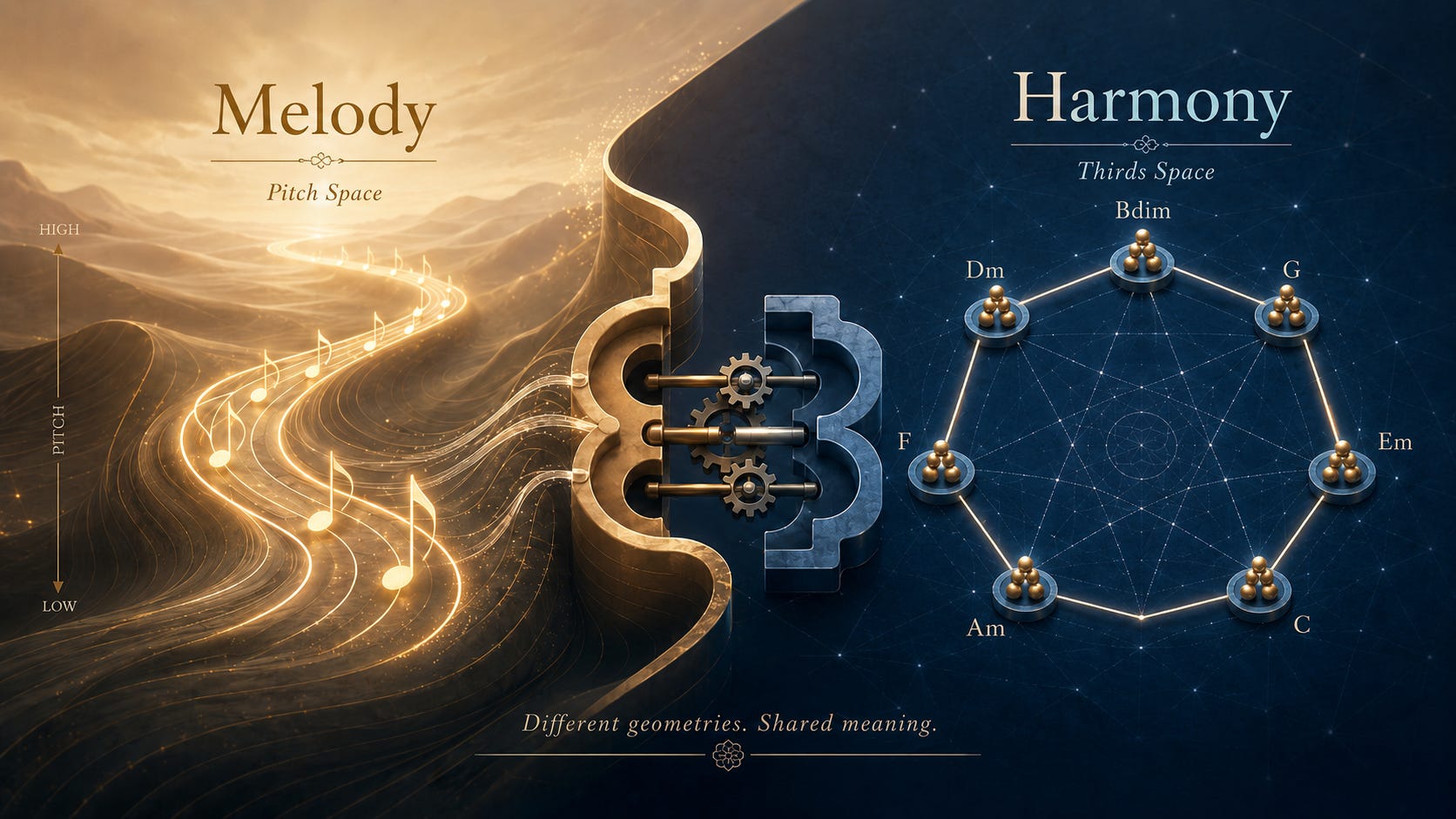
One of the strangest things about music, once you notice it, is that melody and harmony seem to live in different geometries.
Harmony feels local in what I’d call Thirds Space. Melody feels local in ordinary pitch space. And that is odd because melody and harmony are not two separate things loosely stacked on top of one another. They are deeply entangled. The melody strongly constrains what harmony you hear. The harmony strongly constrains what the melody can naturally do. A song is often recognizable from the melody alone precisely because the melody already carries so much harmonic implication inside it.
And yet they do not seem to measure “nearness” the same way.
For harmony, the nearest semantic neighbors of a chord are not usually the pitch-adjacent chords. If you play a C chord and then move to the pitch-adjacent triad, it does not sound like the most local, smooth harmonic continuation. The chords that feel most closely related are typically the ones a third away. Harmony, in other words, seems organized by a Thirds-based metric.
Melody behaves very differently. In melody, c to d feels perfectly natural. So does e to f. So does g to a. Adjacent pitches feel like the most ordinary kind of continuation there is. Melody seems organized by pitch adjacency in a way harmony simply is not.
That gives us a real puzzle. How can two musical layers be so tightly coupled, and yet appear to use different local metrics? If they were truly independent, there would be no mystery. But they aren’t. If they really shared one and the same geometry, there would be no mystery either. But that doesn’t seem true to the phenomenology. Chords do not feel maximally smooth under pitch adjacency. Melodies do.
So any serious theory of music ought to explain this. It ought to explain why chords seem semantically local in Thirds Space, while melody seems locally smooth in Pitch Space, even though the two are woven together so tightly that each helps define the other.
That, to me, is one of the deepest little enigmas in tonal music. It is hiding in plain sight. We all know melody and harmony belong together. We all know melody moves stepwise while harmony doesn’t. But put those two facts side by side and they become a real theoretical demand. Why should they inhabit different local geometries and still function like parts of one organism?
That is the question.
[I have a theory I’m building that explains this, expanding well beyond my work in HARNESSED. But, here, just the mystery.]