


LLMs are now getting so absurdly good at math that frontier systems from OpenAI and Google DeepMind have already hit gold-medal IMO performance — solving five of the six problems at the level of the best human high school competitors on Earth. And these aren’t calculator tricks or benchmark gimmicks. IMO problems require long chains of creative reasoning and full proofs written in natural language.
At this point it seems pretty obvious where this is heading. Competition problems are just the warm-up. Real mathematical discovery is next — and probably at scales and speeds humans simply can’t compete with. Give these systems huge test-time compute, persistent reasoning loops, and formal verification systems like Lean, and they can grind through gigantic hypothesis spaces endlessly, across thousands of parallel copies of themselves, day and night.
And now we’ve crossed another threshold.
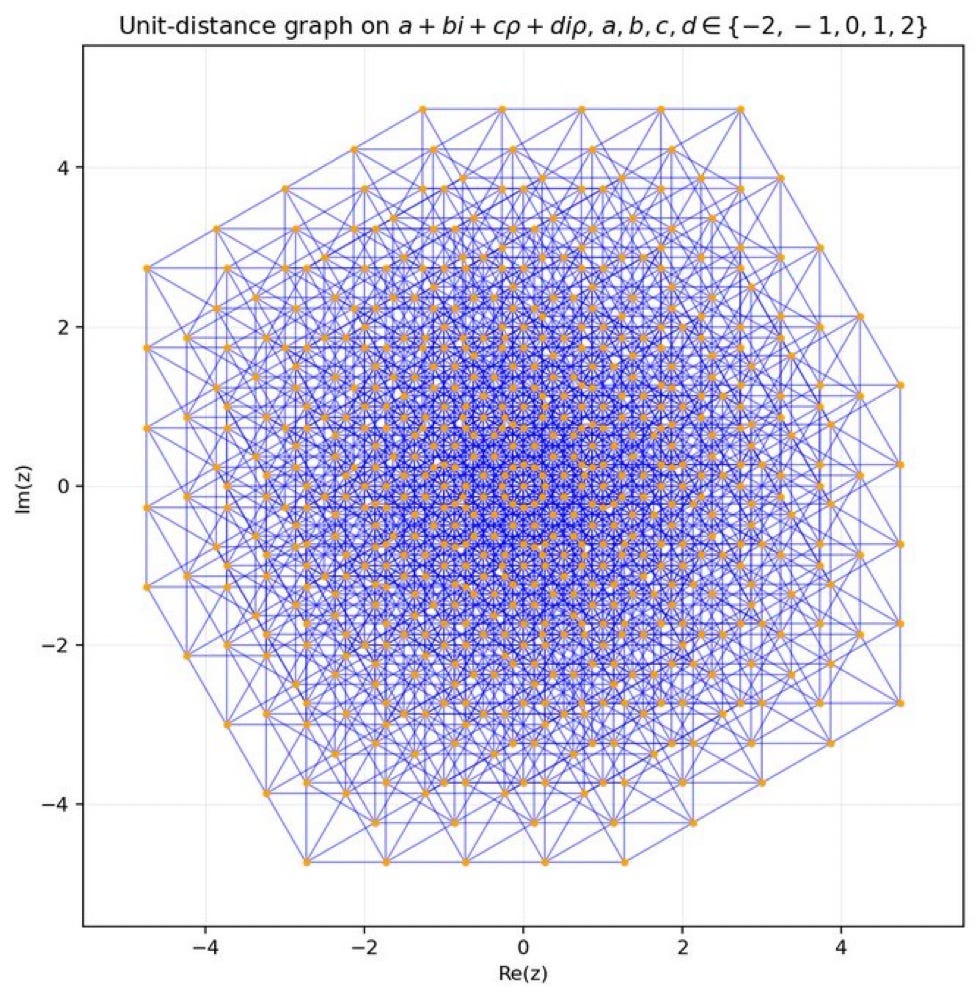
In May 2026, an internal OpenAI reasoning model apparently disproved a major Erdős conjecture in discrete geometry — the unit distance problem from 1946. Erdős conjectured that among n points in the plane, the maximum number of point-pairs exactly one unit apart grows only barely faster than linearly. The AI instead found a new construction giving a genuine polynomial improvement. Human mathematicians reportedly verified the proof and described the methods as elegant and genuinely clever.
That’s a strange moment historically. Because it may be the first time a significant open mathematical problem was solved largely autonomously by AI.
And what’s interesting is watching the reaction.
You immediately start hearing:
“It wasn’t really that important.”
“If an LLM solved it, maybe it wasn’t actually that hard.”
“It was derivative.”
“Not really deep.”
Some skepticism is healthy, obviously. But a lot of this feels psychologically familiar. The trophy is starting to evaporate.
Because many hard math problems functioned socially a little like rare flowers growing on dangerous cliff faces. People valued the flower partly because retrieving it required extraordinary human effort, risk, and talent. But once drones can effortlessly pluck the flowers all day long, the social meaning changes overnight. Suddenly the guy still dangling from ropes to retrieve one manually starts looking less like a hero and more like someone who missed the memo.
That doesn’t mean mathematics itself loses value. Some discoveries genuinely reshape science, cryptography, optimization, physics, engineering, and our understanding of structure itself. AI may massively accelerate all of that.
But a huge amount of the prestige economy surrounding pure math was tied to scarcity. Solving a famous hard problem signaled exceptional human brilliance. It got you reputation, jobs, grants, status.
And now the scarcity may collapse.
What makes this especially eerie is that pure mathematics was always somewhat unusual epistemologically. Unlike experimental science, math does not discover contingent facts about the physical world. It explores the consequences of axioms and definitions. In some sense it is an enormous web of tautological structure — incredibly rich and profound structure, but still ultimately formal.
So there’s something almost fitting about statistical engines eventually becoming extraordinary at it.
And I suspect that, over time, people will quietly stop treating many mathematical discoveries the way they once did. Not because the discoveries cease to matter, but because the social meaning attached to discovering them changes.
The mountain is still there.
But once helicopters exist, fewer people care who climbed it barefoot.