


As AI has developed, I’ve found myself increasingly inhibited from writing my next book.
I have an idea for one. It would be about the evolution and meaning of Western tonal music — the strange cultural system built around the diatonic scale and the chord progressions with which we’re all familiar.
And writing books is hard! I’ve written many. I know.
So shouldn’t I be more motivated to write the next one today? Producing a book is becoming easier than it has ever been. Now, if I actually wrote it today, I’d write it myself, without AI, because I’d want it in my own voice. But set that aside. I’m interested here in the motivations that are going to increasingly take hold as AI gets better.
Until now, writing a book about a scientific discovery required me to be good at two very different things. First, I had to make the discoveries. Then I had to turn those discoveries into a book that was organized, readable, entertaining, accessible and hopefully difficult to put down.
Why should I have to be good at both?
I’m a scientist and theorist. Perhaps I should concentrate on the ideas themselves and let my writing staff explain them to the masses. The fact that my new writing staff happens to be AI just means I no longer need to employ a room full of people to do it.
So I should write my next book with little compunction!
Right?
No.
There are two obvious reasons why the coming ease of creation might actually make creators lessinclined to create.
First, if anyone can do it, the mere fact that you did it loses much of its value.
Second, if everyone can suddenly turn every half-decent idea into a polished book, movie, documentary, album, lecture series or whatever else, there is going to be a massive surge of completed visions competing for everyone’s attention. That alone is quite a disincentive to spend your time making another one.
But neither of those is the big reason.
I’d be willing to compete. My ideas — I think — are better, and one needs to get them out into the competition. If they’re actually better, they should fare well in time.
The trouble is a third and much deeper reason.
And you may already be exhibiting it yourself.
Suppose someone posts an interesting article on social media. Do you always click through and read the whole thing?
Or do you sometimes ask your favorite AI to summarize it?
Someone sends you a 45-minute YouTube video. Maybe you ask Grok to give you the skinny on it first.
If the summary sounds interesting, perhaps you then go back and read the entire article or watch the whole video.
Or will you?
Because you’re already talking about the idea with your AI. It knows what the creator was trying to say. And now it can explain the idea specifically to you.
At your level. Given your background. Given your interests. Given how much time you have. Interactively. With more detail wherever you want it and less wherever you don’t. With objections and counterarguments. With diagrams or other visual aids whenever they would help.
Why go back and consume the creator’s particular instantiation at all?
Sometimes there is an obvious answer. If the instantiation is the art, then of course you want the instantiation. You don’t ask an AI for a summary of a painting and figure you’ve now seen the painting. For some creations, the finished artifact may itself be the shortest specification of the idea.
But very often that isn’t true.
And in those cases, you may never return to the creator’s project at all.
There would seem to be a problem with this argument. The creator still had to make the article or video in the first place. That’s how your AI learned what the creator had to say.
Except it didn’t have to happen that way.
Just as I could now hand AI the substance of a scientific discovery and ask it to expand that into a book, the AI on your side doesn’t actually need my book in order to explain my discovery to you.
It needs the generative core from which my book would have been made.
And if your AI has that, something very strange happens.
I don’t need to write the book.
Your AI can write the book.
Not my book, exactly. Your book.
It can instantiate my idea on the client side, specifically for you.
Which means that even though AI has made it spectacularly easier for me to turn my idea into a completed project, there is increasingly little reason for me to bother doing so.
Everyone else can instantiate it themselves.
The End of the Finished Project
This will happen most obviously when the central value of a work is logical, informational or otherwise compressible rather than residing in its exact instantiation.
Educational books and videos are paradigm examples.
Why should an expert turn an idea into one particular 300-page exposition intended for some imaginary average reader?
One reader needs 40 pages. Another needs 600.
One already understands the mathematics but needs the biological background. Another knows the biology but needs the mathematics explained from scratch.
One wants diagrams. Another wants exercises. Another wants an adversarial presentation that spends half its time trying to destroy the theory. Another wants a two-hour conversational audiobook for a drive.
Why should the creator choose?
But the same thing can reach considerably further into what we now think of as creative works.
Consider a novelist who prides himself less on the precise sentences than on an ingenious story: its world, characters, revelations, causal structure, intricate plot and character development.
That structure might be specified much more compactly than a 400-page novel.
If it’s good, a million people could take that same canonical story and have their own AIs instantiate it as a novel of whatever length and style works for them. Or as a movie. Or a ten-episode television series.
Every one of them might experience a somewhat different artifact while still meaningfully experiencing the same story.
That isn’t even as alien as it sounds.
We’ve been doing something like it with novels for centuries.
You and I can read the exact same novel, yet the worlds generated inside our heads may be radically different. My character has a different face. Your house has a different layout. We hear different voices. We imagine different lighting, timing, expressions and movements.
Then Hollywood makes the movie and produces yet another instantiation.
Yet we have no difficulty saying that we all experienced the same story.
AI simply externalizes and vastly expands the process of instantiation that our brains were already performing.
And that leads to the paradox:
The easier AI makes it for us to instantiate our projects, the less reason there is for us to instantiate our projects.
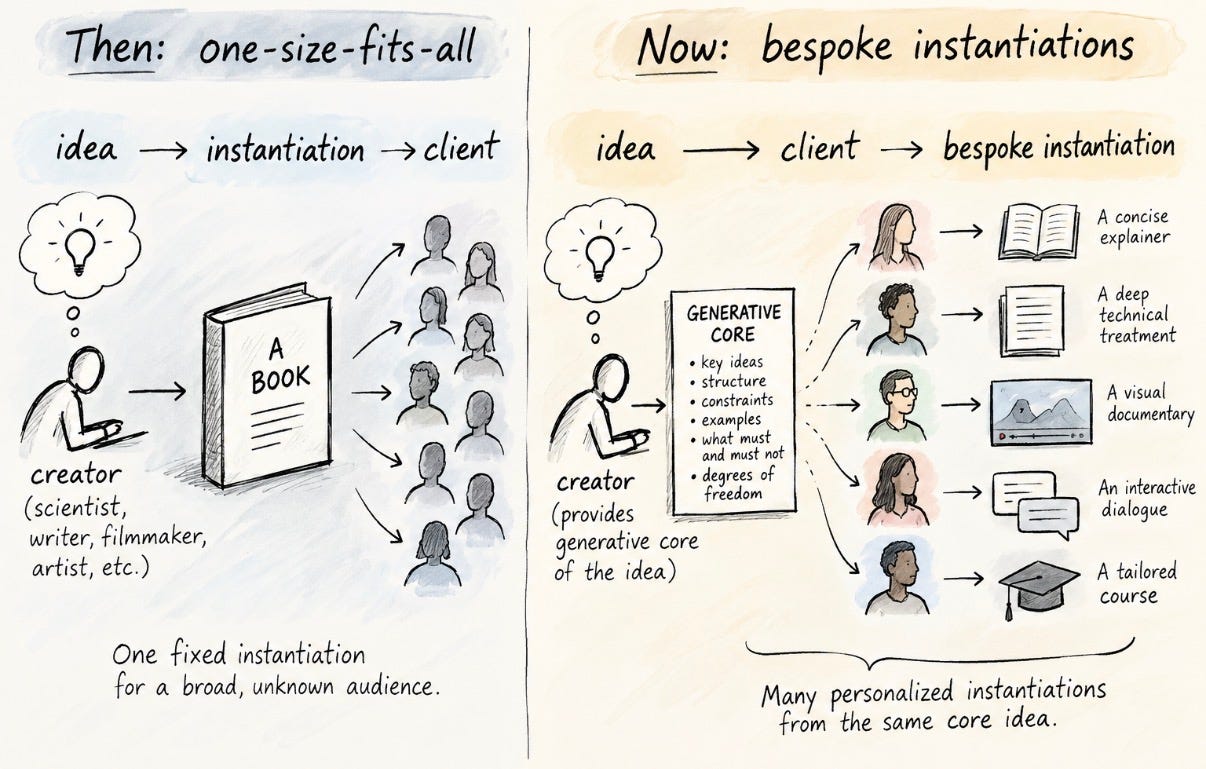
Instead, we’ll increasingly be incentivized to create just the generative core of the project — the canonical specification of the vision.
Those interested in it can then have their own AI create a bespoke instantiation, tailored to their interests, needs and level.
Historically, cultural production has looked something like:
idea → instantiation → client
discovery → book → reader
AI increasingly allows:
idea → client → bespoke instantiation
discovery → reader → book tailored to that reader
Notice what has happened.
The instantiation and the client have switched places.
For most of cultural history, I had to instantiate my vision before knowing you. I had to choose the words, length, examples, pacing, visuals and medium, freeze all of that into an artifact, and then send that artifact out into the world in search of people for whom those choices happened to work.
Now the client can arrive first.
Only then does the instantiation need to exist.
So What Should I Write?
Which leaves me with the distinct impression that my next book — perhaps this new idea about the cultural evolution and meaning of Western tonal music — shouldn’t be a book at all.
I should create the thing from which the books would be generated.
That thing would have to be designed differently.
It should be optimized not primarily to be read straight through by a human, but to be completely and accurately grasped by an AI. It should contain the full structure of the theory: its claims, definitions, evidence, logical dependencies, examples, qualifications, implications, boundaries, objections and replies.
It would need to be generatively complete.
In some ways it might resemble a patent. A good patent is not merely one particular implementation of an invention. It attempts to specify what the invention is, across a range of possible implementations, distinguishing what is essential from what is incidental.
A generative intellectual object would attempt something analogous.
I might still generate one particular instantiation — perhaps even something resembling a conventional book — to introduce the idea to the world.
But that wouldn’t really be the product.
The product would be the generative core.
Interested?
Grab it.
Put it into your AI.
Tell it who you are, what you know, what you care about and what you’re trying to accomplish. Have it grow the idea into whatever form best allows you to understand, interrogate or use it.
For someone it becomes a book.
For someone else, a five-page explanation.
For another, an undergraduate course.
For another, an adversarial dialogue.
For another, a documentary.
For another, an interactive simulation.
For another, a two-hour conversation.
And eventually the same principle will apply to stories, movies, television series, games and creative forms we haven’t invented yet.
This would mean the decline of the fixed final instantiation.
But hardly the decline of creation.
Quite the opposite.
It would put greater emphasis on identifying exactly where the genuine creative contribution resides — what the actual idea is, what belongs to it, what is essential, what may vary, and where its boundaries lie.
And surrounding every worthwhile idea could be an effectively unlimited cloud of instantiations, varying in form, length, depth, style and function, generated anew for every person and every purpose.
AI may make it possible for creators to finally complete almost any vision they can imagine.
And precisely because of that, we may stop completing them.
Interesting idea! I think finding a “ generative core” would bedifficult except for narrow topics. How would you ever know if you had specified your topic enough? Thanks! Food for thought.