


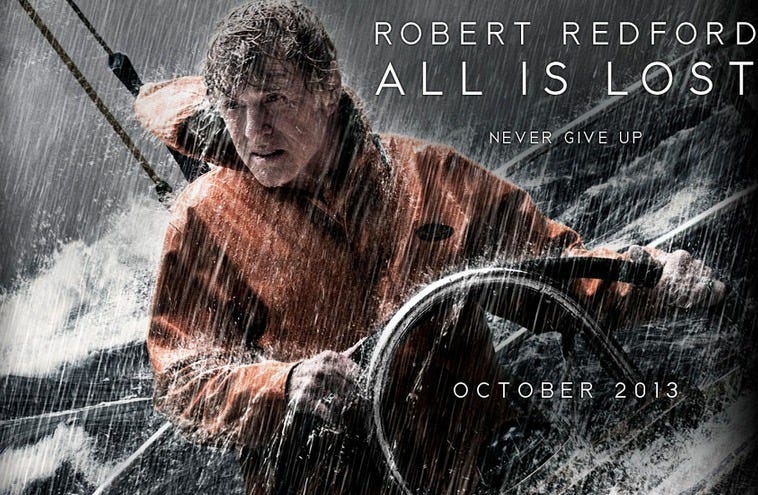
Robert Redford won a major acting award for a performance with almost no dialogue.
The entire movie contains only twenty words.
In an hour and forty-five minutes.
How is that even possible? And what does it reveal about the real language humans - and every other intelligent social animal - actually relied on for millions of years?
In the riveting 2013 movie All Is Lost, Robert Redford plays a captain alone on his sailboat trying to stay afloat after it’s been struck by another vessel. It was a physically demanding role for the seventy-seven-year-old, and his compelling work earned him the New York Film Critics Circle award for best actor.
So far that sounds pretty unremarkable. A devastatingly handsome, Academy Award-nominated veteran actor wins yet another award for acting. Yawn.
But that movie wasn’t like your typical movie. And Redford’s acting requirements weren’t quite, uhm, normal. Usually we imagine how difficult it is for actors to memorize all those lines. Well, in this case, Redford basically didn’t have any lines. In fact, the entire movie contained only twenty words. Total. In the entire hour and forty-five minutes. Yet he still won an acting award!
That is weird.
A movie without words is indeed a rare novelty. When such modern movies are made, many are modeled after old-fashioned silent films (ones where we can see, but not hear, the characters talking), are about a deaf character (who is usually signing), or feature animals for their leads. All Is Lost doesn’t fall into any of these categories.
As weird as this movie is, it’s great for inspiring some thought experiments about how real life is even more weird. While a movie without dialogue is very rare - and usually carries an extremely limited market appeal - up until relatively recently humans lived without dialogue altogether.
We don’t know exactly when we gained language skills. Estimates are in the ballpark of hundreds of thousands of years ago. Prior to that, while humans were basically identical to today, biologically, they spoke nary a peep. We were ready for language, but in lingo limbo.
Sit back and let that sink in. Imagine going even one whole day among your family and friends with no one speaking. (It would be wonderful, yes?!) Of course, that would mean no texting or writing of any kind either. You still have to prepare a lasagna, though. So you need your spouse to run to the store to grab ground beef and tomato sauce. You need to get your son to chop the onions (because he’s the one with cry-proof contact lenses) and find the pasta you accidentally left in the wrong place in the scary part of the basement. And you need to talk on the phone to your mom about grandma’s recipe, which is what makes the lasagna worth doing. Going even one day without language feels almost unimaginable. So, visualize a week of that. Imagine one month. A whole year. An entire life!
And it’s not just us humans who, before the advent of language, dealt with the deafening silence. Our prehuman ancestors and our hominid cousins were basically like us - similarly toiling through their lives… wordlessly.
The more you think about this, the more difficult it might be to imagine. Nearly the entire history of our human lineage is one long movie without dialogue. Borrrrring!!
Words are the newcomer. Emotional expression was our original language - an ancient, richly structured signaling system that let intelligent social creatures negotiate conflict, cooperate, reconcile, threaten, reassure, deceive, forgive, and bond long before anyone uttered a sentence.
Expressly Human develops a unified theory explaining why our expressions have the precise forms they do, how they evolved, and why they’re still the language we rely on most today, even if we rarely notice we’re speaking it.
(This was an adapted excerpt from Expressly Human.)