


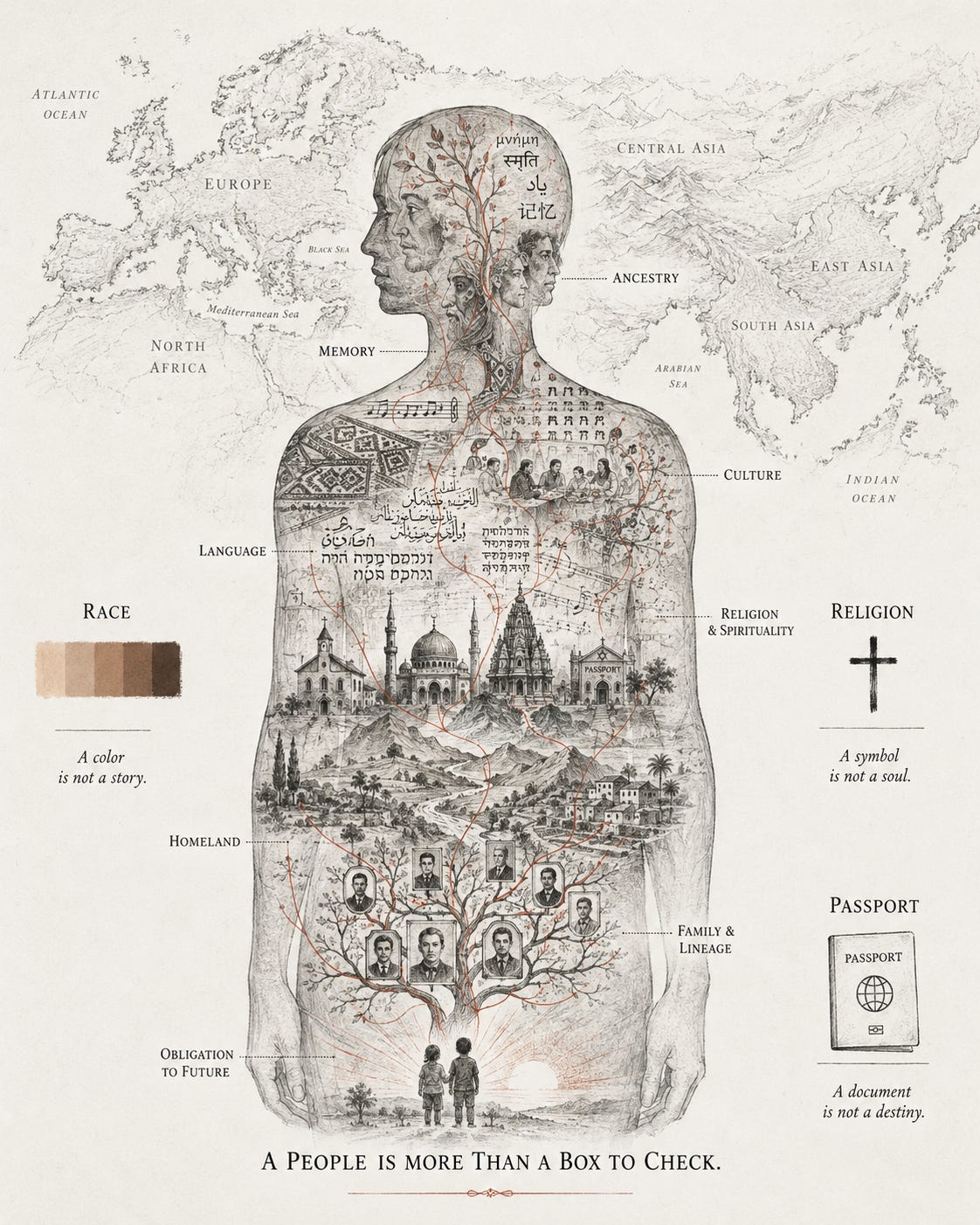
People often don’t understand the difference between a race, a religion, and a people.
They tend to focus on the first two. But much of human history is really about the third.
A people is not simply a race. It is not simply a religion. And yet it is usually entangled with both. A people is a long-lived human community, bound by ancestry, memory, language, custom, ritual, homeland, sacred places, humiliations, victories, migrations, enemies, and obligations passed from one generation to the next.
Those of us in the New World are often slower to grasp this, because New World nations are not usually organized around a single historic people. The United States, Canada, Brazil, Argentina, Australia, and others absorbed vast numbers of diverse peoples and built nations out of them. Americans can be called “a people,” but usually in a thinner and more recent sense than the word carries through much of the Old World.
The rest of the world is teeming with peoples.
Some have states. Some are stateless. Most states contain multiple peoples, often with one principal historic people at the center. Germans, Koreans, Persians, Jews, Armenians, Greeks, Turks, Kurds, Basques, Copts, Assyrians, Tibetans, Uyghurs, Tamils, Pashtuns, Han Chinese, Japanese, Arabs, Berbers, Somalis, Yoruba, Igbo, Amhara, Oromo, Zulu, and countless others are not merely “races” or “religions.” They are peoples.
This is why New World categories so often fail when projected onto the rest of the planet.
“White people” are not a people. They are not defined by a shared religion. And they are not even a race in any deep biological sense. “White” is a racialized umbrella term, something like using “seafood” to group fish, crabs, and octopus — creatures that may share a marketplace category, but not a single lineage.
Black Americans, by contrast, have a stronger claim to being a people, because they were forged through a shared historical ordeal: slavery, segregation, prejudice, civil-rights struggle, and the creation of distinct institutions, dialects, music, religious traditions, and political memory. But even there, “Black” is not a race in the simplistic biological sense people imagine. Africa contains more genetic diversity than the rest of humanity combined, and “Black” collapses vast ancestral worlds into a single American social category.
In much of the rest of the world, the more basic unit is the people.
Peoples are shaped by culture, religion, ancestry, memory, homeland, and continuity. Not by cartoon notions of race. A people can absorb outsiders. It can change genetically. It can convert religiously. It can migrate, intermarry, fragment, reform, and still remain recognizably itself, because what persists is not a pure bloodline but an inherited civilization.
That inheritance tells people who they are, where they came from, whom they mourn, what they owe their children, what lands are sacred to them, what language carries their grandparents’ ghosts, and what catastrophes they refuse to let happen again.
Race is too crude. Religion is too narrow. Citizenship is often too recent. Ideology is too thin.
Peoples are the deep structure.
Ignore peoples, and much of history becomes unintelligible. You cannot understand Jews, Armenians, Kurds, Persians, Greeks, Tibetans, Koreans, Japanese, Ukrainians, Copts, Assyrians, or countless others merely by asking what race they are or what religion they practice. Those questions miss the thing itself.
A people is the human vessel through which ancestry, memory, culture, religion, language, homeland, and obligation are carried forward.