


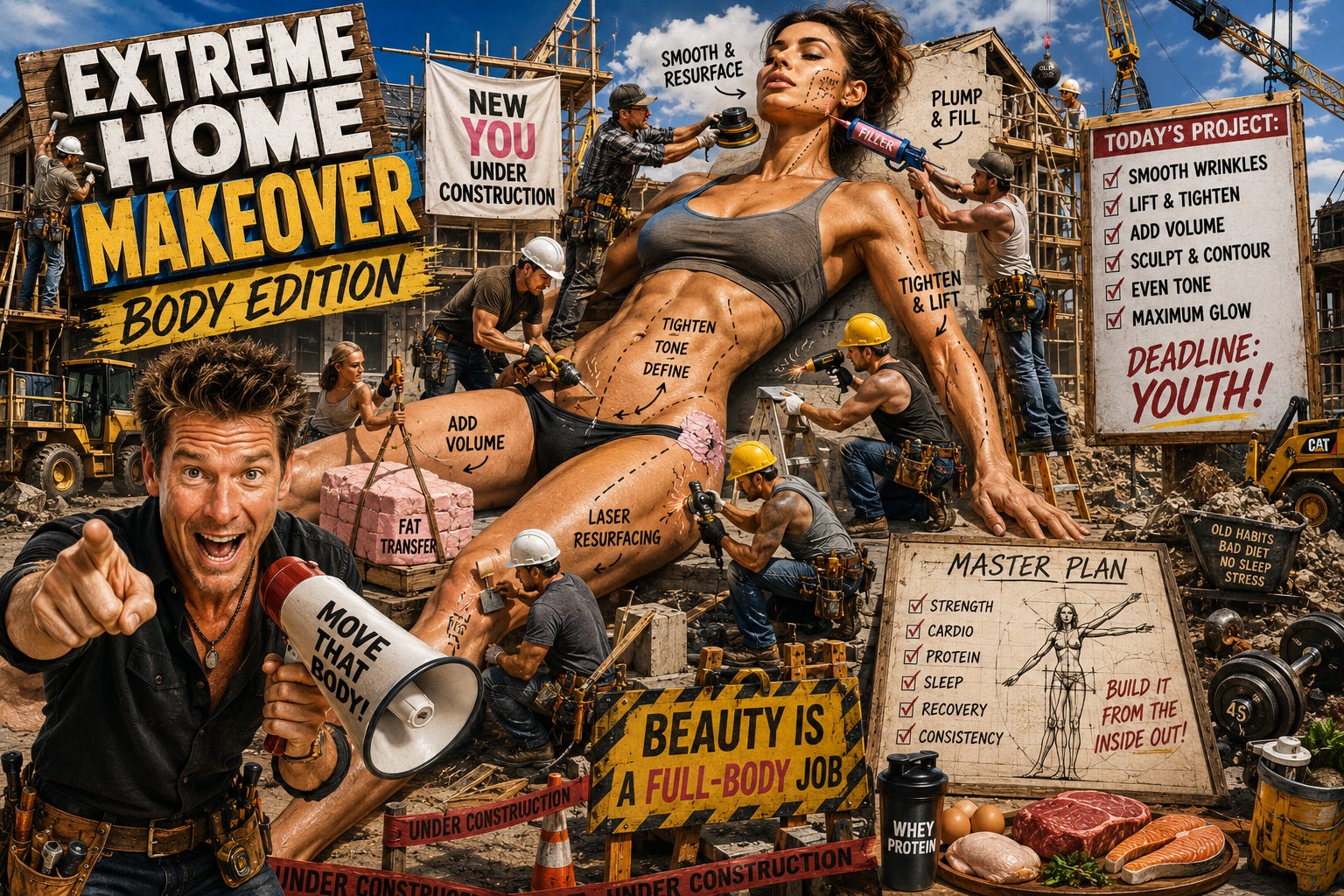
A lot of people carry around an implicit model of skin that is basically… carpet. Or drywall. Or upholstery.
Not consciously, of course. But their behavior reveals the model. They treat skin as an inert covering material whose youthful appearance depends mostly on surface maintenance and repair.
Wrinkle? Pin the rug down.
~ Botox — nailing down a crease.
Sagging? Pull the fabric tighter.
~ Facelift — re-stretching upholstery.
~ Thread lifts — suspending drooping fabric with wires.
Lost volume? Add padding underneath.
~ Fillers — stuffing material beneath sagging carpet.
~ Fat transfer — shifting couch stuffing between cushions.
Surface texture degrading? Sand it smooth.
~ Laser resurfacing, chemical peels, microdermabrasion — sanding, stripping, and buffing flooring.
Discoloration? Repaint it.
~ Foundation, concealer, spray tan, bleaching — fresh paint, touch-ups, staining, or repainting walls.
Dryness? Condition the material.
~ Moisturizers, hyaluronic acid, anti-aging creams — polishing leather or rehydrating dried caulk.
The entire framework is profoundly non-biological. Skin is treated as a surface engineering problem.
But skin is not upholstery. It is a living, vascularized organ. What we perceive as “healthy youthful skin” is largely not a surface phenomenon.
Healthy skin is richly perfused with blood. It sits atop musculature, fascia, fat, lymphatics, and bone. It is hormonally responsive, mechanically adaptive, immunologically active, and metabolically dynamic.
In fact, human trichromatic color vision itself evolved largely to read the blood beneath the skin — pallor, flushing, oxygenation levels, emotional states, and overall health. That was my 2006 discovery on the origins of primate color vision. The famous “glow” of youthful skin is literally vascular.
Maintaining that glow therefore depends on maintaining the underlying living system:
~ Cardiovascular fitness and circulation
~ Muscularity and resistance training
~ Protein-rich nutrition and metabolic health
None of these have analogs in home improvement. Drywall does not become youthful from sprinting. Carpet does not glow from oxygenated blood. Upholstery does not adapt positively to heavy resistance training.
Modern cosmetic culture often behaves as though youthful appearance were primarily a matter of patching and coating a deteriorating surface, rather than cultivating the health of a living organ.
Your body is not a home improvement show. There is no contractor coming to youthify you with fillers, sanders, heat guns, or upholstery tricks.
The closest thing we have to genuine, long-term rejuvenation remains the ancient, boring answer: hard exercise, cardiovascular strain, resistance training, muscular development, high-protein diets, sleep, and recovery — the things that continually rebuild the body from within.