


For most of human history, you got one life.
Not biologically. Socially.
You had one reputation, one career, one community, one public identity. If you wanted to reinvent yourself, you usually had to burn the old one down.
Then social media quietly changed one of the deepest constraints on human creativity.
It gave ordinary people multiple parallel lives.
No, not in the psychological sense. In the evolutionary sense.
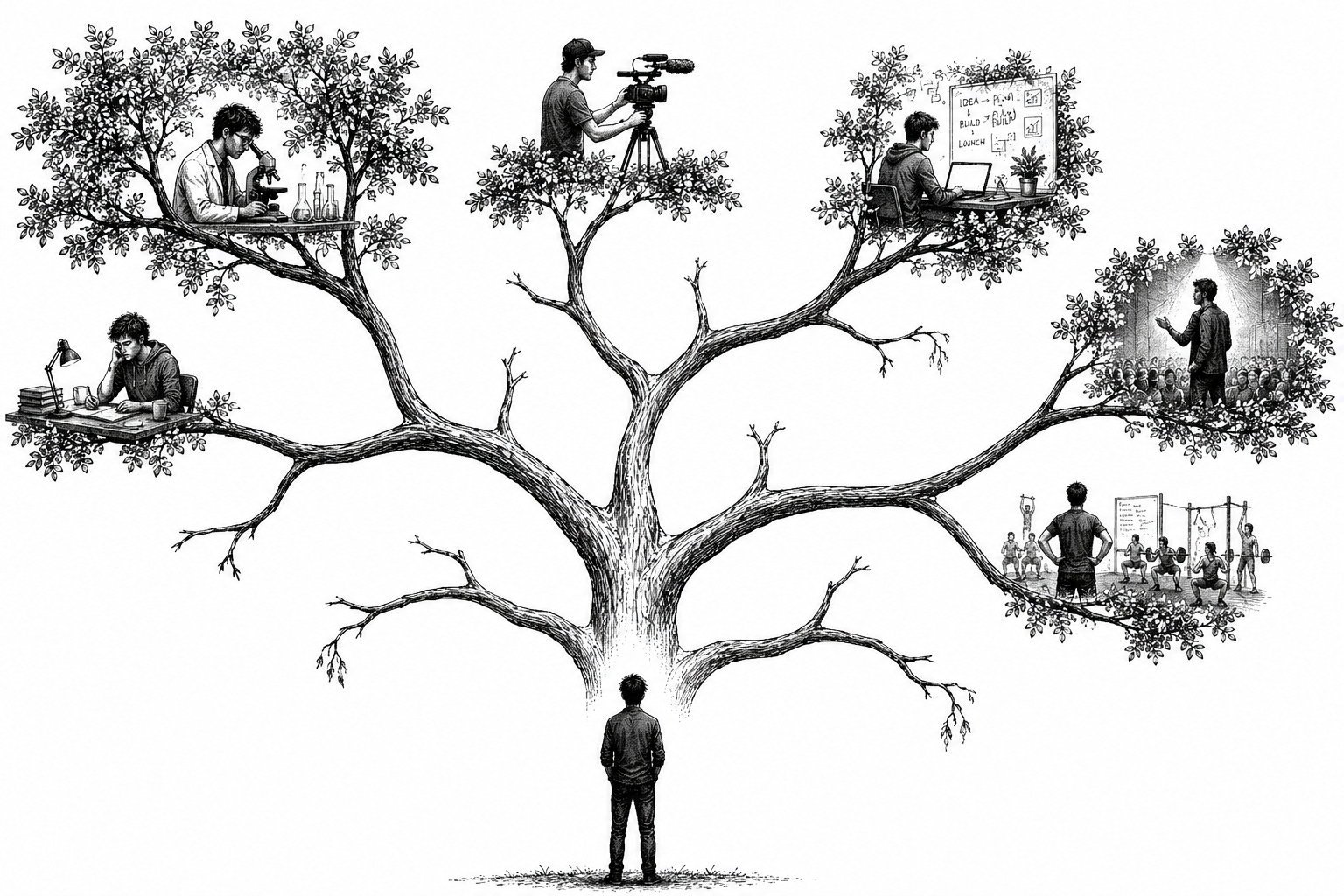
One person can now simultaneously be a scientist, a filmmaker, a local journalist, a startup founder, a political commentator, and an expert on medieval maps—each with its own audience, reputation, collaborators, and opportunities. Most of these parallel lives fail. A few flourish.
I suspect this ability to run multiple public experiments at once may prove to be one of social media’s most important—and least appreciated—contributions.
People who don’t spend much time online often see social media as little more than narcissism at scale: billions of people posting photos, opinions, and videos in the hope that strangers might pay attention.
They’re not entirely wrong. But they’re also missing something.
With billions of people now participating across X, YouTube, Instagram, TikTok, LinkedIn, Substack, podcasts, Discord servers, and countless niche communities, something genuinely new has emerged. Most commentary focuses on the obvious candidates: unprecedented interconnectedness, information moving at lightning speed, global collaborations, algorithmic feeds, and the creator economy.
But after spending years immersed in this world, I came to think that one of social media’s most important innovations has received remarkably little attention.
It lets us conduct multiple lives in public.
The title of this essay calls them “multiple personalities,” but that’s really just a metaphor. What I mean is that a single person can now cultivate several distinct public identities, each living in its own community.
One person might simultaneously run a science channel on YouTube, a startup newsletter on Substack, a local news account on Instagram, a political account on X, and an anonymous account devoted to an obscure hobby. Each develops its own audience, reputation, collaborators, and opportunities. Some quietly disappear. Others unexpectedly flourish.
When I first noticed this, I found it vaguely unsettling. “Figure out who you are and stick with it,” was my instinctive reaction.
Over time, however, I found myself changing my mind.
The reason is that this isn’t really a story about social media at all. It’s another example of a much deeper principle.
One of the recurring themes across biology, science, markets, and culture is that progress comes from variation followed by selection. Evolution produces countless mutations and natural selection preserves the few that work. Markets generate thousands of startups, knowing that almost all will fail. Scientific communities pursue many competing hypotheses, expecting most to be wrong.
The same algorithm keeps reappearing.
Progress depends upon running many experiments.
For most of history, each person effectively got one public experiment. You pursued one profession, developed one reputation, and belonged to a relatively small number of communities. If you wanted to try something radically different, the costs were often prohibitive. You risked the reputation you had already spent years building.
Social media changed the economics of that gamble.
Instead of placing one enormous bet on a single public identity, we can place several smaller bets. Each identity explores a different intellectual ecosystem. Each finds a different audience. Each competes under different selection pressures.
Of course there are limits. Spread yourself across twenty identities and each receives too little attention to thrive. But a handful of well-maintained identities can substantially increase the probability that one of them finds fertile ground.
The important change is that one person can now run several creative experiments at once.
A scientist can also become a writer. A fitness coach can try making films. An entrepreneur can build a local news channel. Someone fascinated by medieval maps or octopus behavior can discover thousands of people who share the obsession. None of these experiments requires abandoning the others.
Most won’t amount to much.
That’s exactly what we’d expect. Evolution works because most mutations fail. Markets work because most startups fail. Science advances because most ideas fail. Exploration is inherently wasteful—and that’s what makes it so productive.
Seen this way, social media is much more than a communication technology. It lowers the cost of creative experimentation.
People become willing to try things they otherwise would never have attempted because failure no longer means sacrificing everything they’ve already built. If one experiment fizzles, the others continue.
The result is a society running vastly more experiments than ever before.
More ideas are tested. More communities form around unlikely interests. More collaborations emerge. Every so often, one of those experiments changes a person’s life.
Perhaps one day we’ll look back and conclude that this—not the influencers, not the memes, not the endless scrolling—was social media’s greatest contribution.
It allowed millions of ordinary people to explore several possible versions of themselves instead of just one.
And whenever evolution gets to run more experiments, remarkable things tend to happen.