


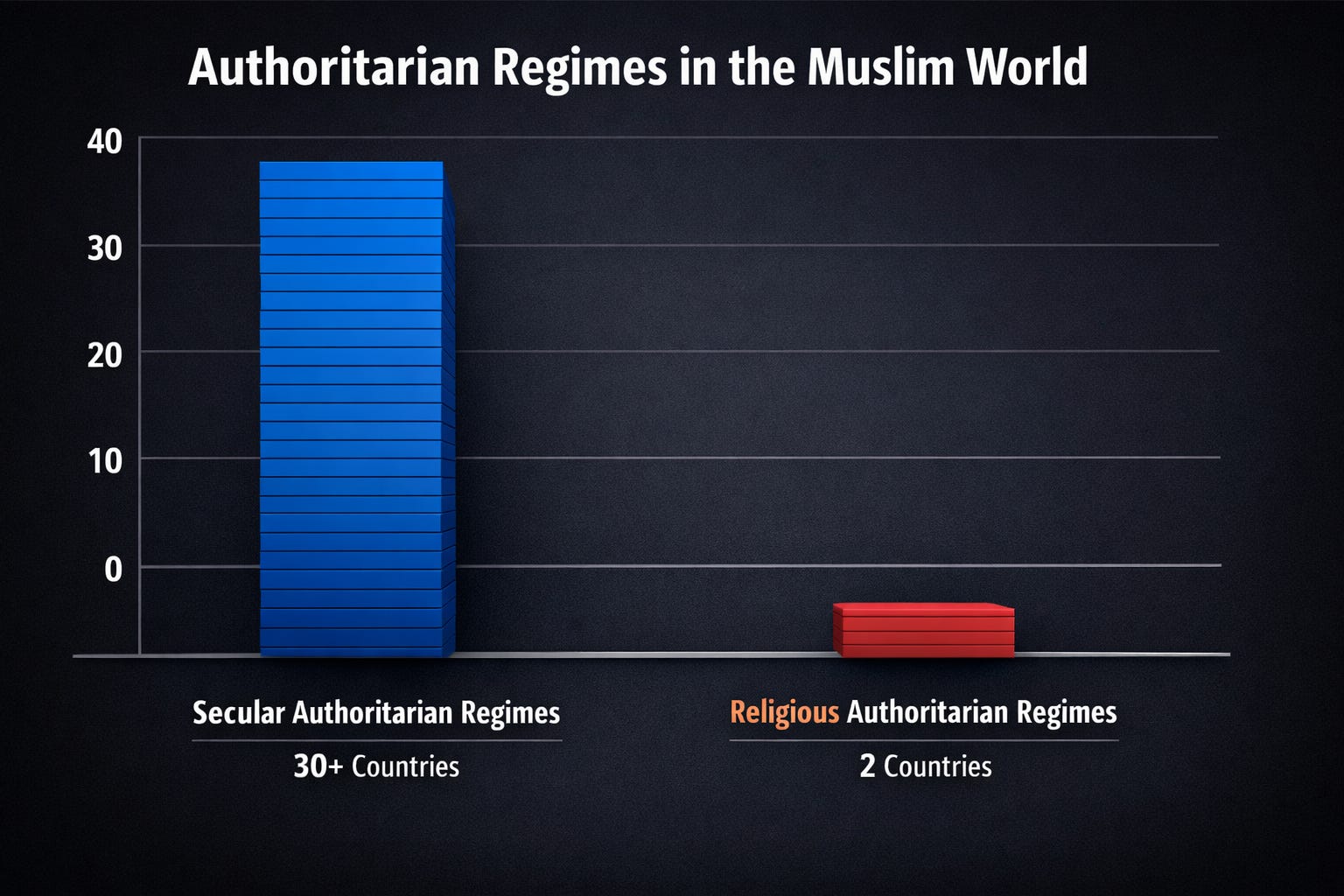
Across all the talk about caliphates, Islamism, and supposed Islamic varieties of fascism, what’s striking is how few actual Islamist totalitarian regimes there have been in the Muslim world.
In the last century, there are really only two clear examples:
~ The Islamic Republic of Iran
~ The Taliban’s Islamic Emirate of Afghanistan
You might nod toward Hamas — but even there, it’s debatable whether they qualify as a governing regime in any serious sense. They have mostly operated as a militant movement that incidentally administers territory when convenient. And ISIS briefly attempted a state-like theocracy, but it was short-lived and never consolidated into a durable governing order.
By contrast, the Muslim world has been dominated not by religious totalitarianisms, but by dozens of secular authoritarian regimes of many different flavors:
~ Royal / monarchical authoritarianism — Saudi Arabia, Jordan, Morocco, Gulf kingdoms
~ Military-strongman authoritarianism — Egypt (Nasser, Sadat, Sisi), Iraq (Saddam), Syria (Assad), Algeria
~ Revolutionary-nationalist authoritarianism — Ba’athist states, PLO factions, Nasserism
~ Socialist or quasi-socialist one-party regimes — South Yemen, early Sudan, parts of the Maghreb
~ Committee-style / technocratic oligarchies — UAE-style council governance, hybrid elite coalitions
~ Post-colonial patronage-state authoritarianisms — Pakistan, parts of Central Asia, North Africa
Depending on how you count them, we’re talking several dozen secular or non-theocratic authoritarian systems — versus perhaps two genuinely Islamist totalitarian ones.
In other words, the core problem in much of the Muslim world has not been religion-based tyranny, but authoritarianism in general — just as it was in the West until barely half a century ago.
And just as in the Judeo-Christian world, authoritarianism has often worn religious clothing at times — but by far most of it has been explicitly secular, nationalist, militarized, or ideological rather than theological.
Which is why, in the case of Iran, the crucial point is this:
What must be overthrown is authoritarian rule itself — its surveillance, its repression, its political unfreedom — not merely its clerical costume.
And more broadly, the hope for the Muslim world is not the replacement of one style of authoritarianism with another, but a decisive move away from authoritarianism altogether — in all its flavors.
May Iran’s mullah regime fall swiftly, may Iran rise as a free, secular democracy, and may it stand as an example across the Muslim world that civil liberties, pluralism, and self-government are possible — and worth fighting for.