


I’ve been working for several years on a new, deeper theory of the origins and meaning of music.
In Harnessed, 15 years ago, I described how music sounds like a human moving evocatively in your midst. But I did not then have a theory of why we tend to like the usual (diatonic) scale, what chords mean, what melody means, or how they all fit together.
But now I do. And it’s breathtakingly beautiful.
And, by the way, AI hasn’t helped a bit. Not that I didn’t try to get useful help — it’s just nowhere near ready to make these sorts of creative leaps in science. Maybe next year. Lol.
The theory — MOTION SPACE THEORY — in its most unifying (and least reader-friendly) statement is this:
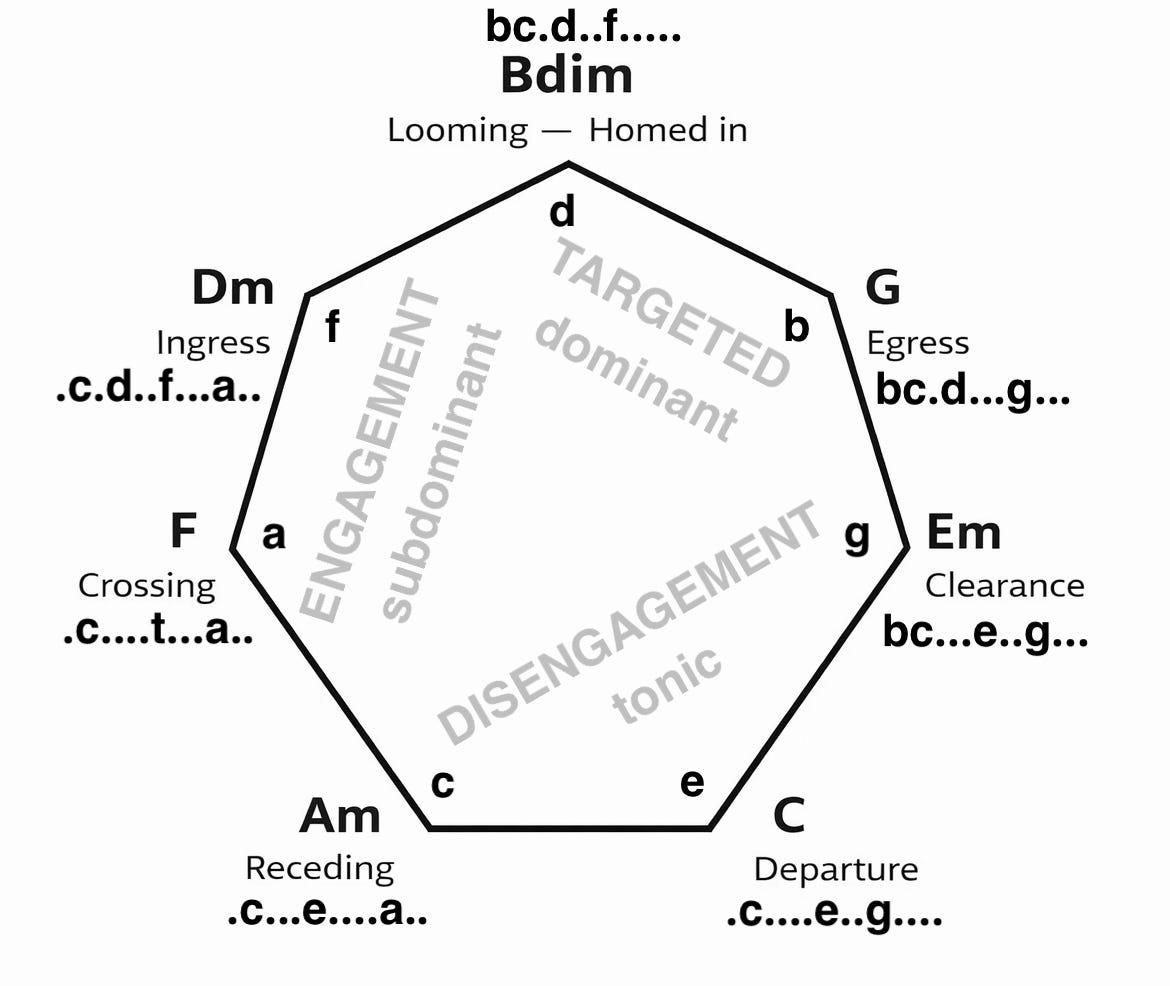
Motion Space Theory proposes that the diatonic scale’s Thirds Space has the geometry needed to represent the changing directions of human movement along a trajectory past an observer. The bulk motion of the extended body through this space gives rise to chords and harmony, while the oscillatory motion of its articulated parts gives rise to melody. The diatonic scale is unique in its ability to enable all of this.
What I find most surprising is that chords and melody — two seemingly very different pillars of music — fall out of the same underlying theory. And they get grounded in exactly the thing that could explain why music is so emotionally evocative, and why it is so deeply connected to dance: the detailed dynamics of a human moving near you — their trajectory, parallax, rotations, and the oscillations of their head, limbs and other body parts.
Working on the final article now. Or book.
Although, as I’ve discussed recently, I’m not sure there’s quite the reason to write books anymore. Once I write the paper, you’ll be able to have your favorite AI create a bespoke book for you about the theory. 🤷
(The diagram is a little peek under the hood. Don’t worry, you’re not supposed to understand it yet. 😎)