


One often hears that the Muslim world is somehow uniquely prone to authoritarianism, as though Islam itself naturally produces dictatorships while Christendom naturally produces liberal democracy.
But is that actually true?
One way to approach the question is to separate authoritarianism itself from the narrative used to justify it. Some regimes explicitly ground their legitimacy in religion. Others justify authoritarian rule through nationalism, socialism, anti-communism, revolution, race, military necessity, or other secular narratives. If our interest is understanding the political tendencies of civilizations, both kinds matter. A population that repeatedly falls under authoritarian rule is exhibiting an important historical pattern regardless of whether that rule is wrapped in religious or secular language.
And, in my view, these narratives are often largely post hoc rationalizations: political vocabularies that evolve to legitimize power, hierarchy, repression, and group loyalty after the underlying authoritarian dynamics are already in motion. Religion may supply that vocabulary. So may nationalism, socialism, race, revolution, or security.
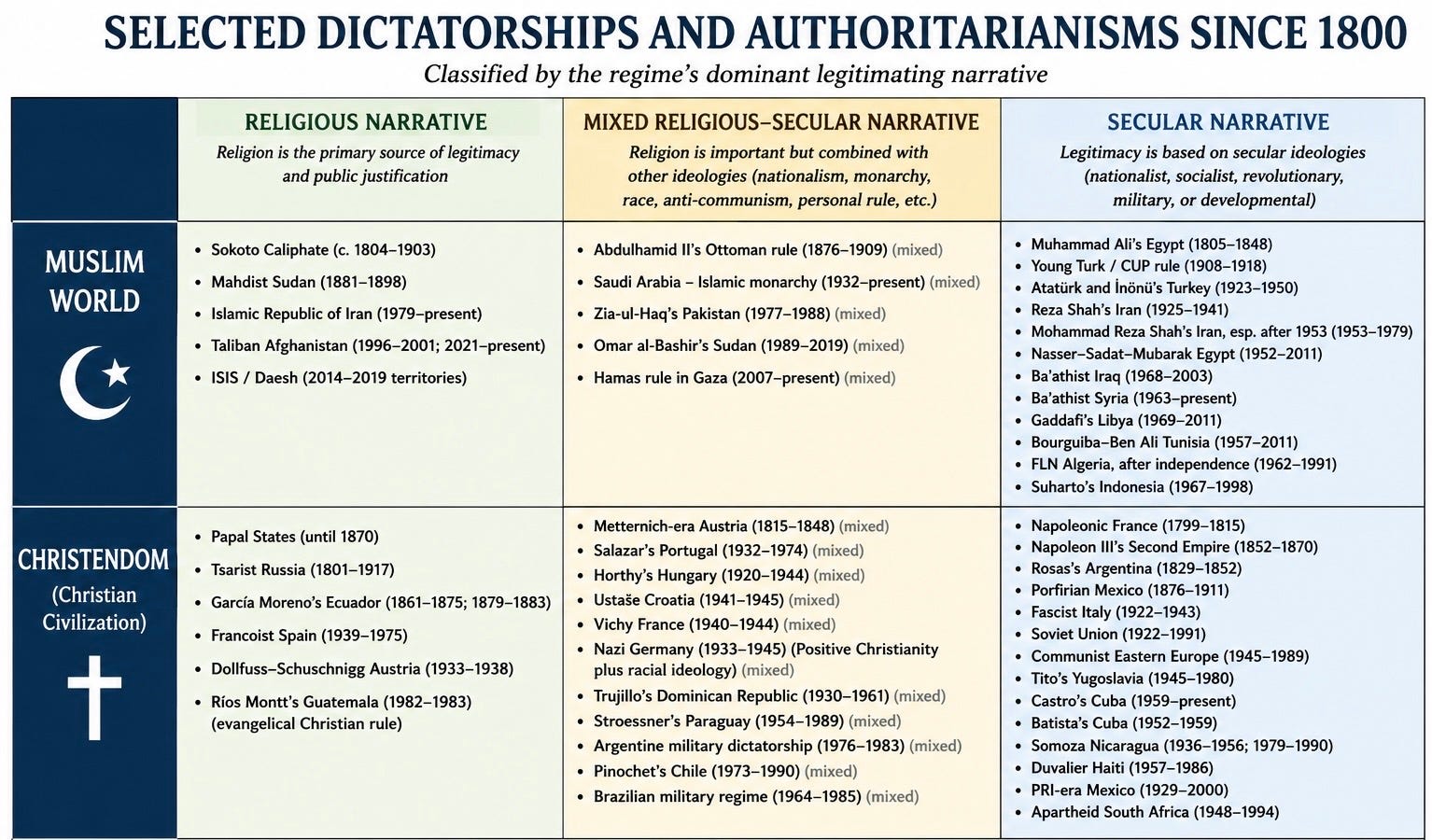
The table above surveys selected authoritarian regimes since 1800 across the Muslim world and Christendom, classifying each according to its dominant legitimating narrative: religious, mixed religious–secular, or secular.
The broad pattern is striking. Both civilizations have produced numerous religiously justified authoritarian regimes, numerous secular authoritarian regimes, and many hybrids. In both worlds, secular or mixed narratives account for at least as many examples as overtly religious ones.
None of this is to deny that much of the Muslim world faces greater authoritarian problems today. It plainly does. But much of the non-Western world also remains economically and institutionally behind the leading Western countries—perhaps by something like half a century in some respects. And half a century ago, many countries now treated as securely liberal and democratic were themselves emerging from fascism, military rule, dictatorship, political violence, or profound institutional instability. Latin America and Eastern Europe, though part of the broader Christian world, have likewise lagged behind Western Europe and North America and have experienced much more authoritarianism. A developmental gap is therefore easily misread as a civilizational essence: societies are behind, and the explanation offered is simply “Islam.”
The larger lesson is that authoritarianism appears to be a recurring political phenomenon that different civilizations justify using different vocabularies. Religion is one possible narrative. Secular ideologies are another. Neither Christianity nor Islam, by itself, adequately explains why societies repeatedly fall into authoritarian rule.