


When people imagine traveling to the stars, they imagine better ships.
Bigger engines. Faster engines. Better shields. Better sensors.
The assumption is so natural that we rarely question it. Space is almost completely empty, so surely the challenge is simply building a vehicle capable of crossing that emptiness.
But what if that’s exactly backwards?
My colleague Dr. Tim Barber has emphasized a simple observation that turns our intuition on its head. Space is indeed extraordinarily empty. Yet as speeds rise, that emptiness becomes increasingly dangerous.
At everyday speeds, a dust grain is a dust grain. At a significant fraction of the speed of light, a dust grain is a bullet. At still higher speeds, a tiny grain can carry the energy of an explosive. The problem is not that space contains a lot of stuff. It is that the rare bits of stuff it does contain become catastrophically dangerous.
The usual response is to imagine better sensors. But Tim’s analysis suggests that sensing itself may become the dominant obstacle. To avoid collisions, a ship must illuminate an ever-larger volume of space farther and farther ahead, while also detecting increasingly tiny objects with enough warning to react. The power required for this grows extraordinarily rapidly. Depending on the assumptions, the sensing burden scales faster than the fifth power of velocity.
That scaling is brutal. Double the speed and the perception challenge grows by more than a factor of thirty. Increase speed by a factor of ten and the sensing challenge grows by more than one hundred thousand times.
The implication is startling. Even if propulsion were somehow solved, perception might not be. In fact, realistic estimates suggest that a self-contained ship attempting to detect and avoid all dangerous particles may encounter practical speed limits around 0.0003c if it is genuinely expected to survive the journey and arrive intact.
Whether that particular number ultimately proves correct is less important than the broader lesson. The obstacle may not be moving fast enough. The obstacle may be seeing far enough.
This suggests a surprising possibility.
Perhaps interstellar travel is not primarily a ship problem at all. Perhaps it is an infrastructure problem.
We resist this idea because space appears empty. Why would one need infrastructure in emptiness? Yet every transportation revolution in human history has eventually discovered the same lesson. The faster we move, the more intelligence migrates from the vehicle into the environment.
A person walking through wilderness carries all of the navigation burden. A horse does as well. Roads remove part of that burden. Railroads remove even more. A train succeeds because someone already surveyed the route, graded the terrain, laid the tracks, and maintained the corridor. The train itself becomes simpler because the environment has become smarter.
The standard science-fiction picture imagines starships as glorified horses: completely self-contained vehicles roaming freely through empty space. But perhaps the future looks more like railroads.
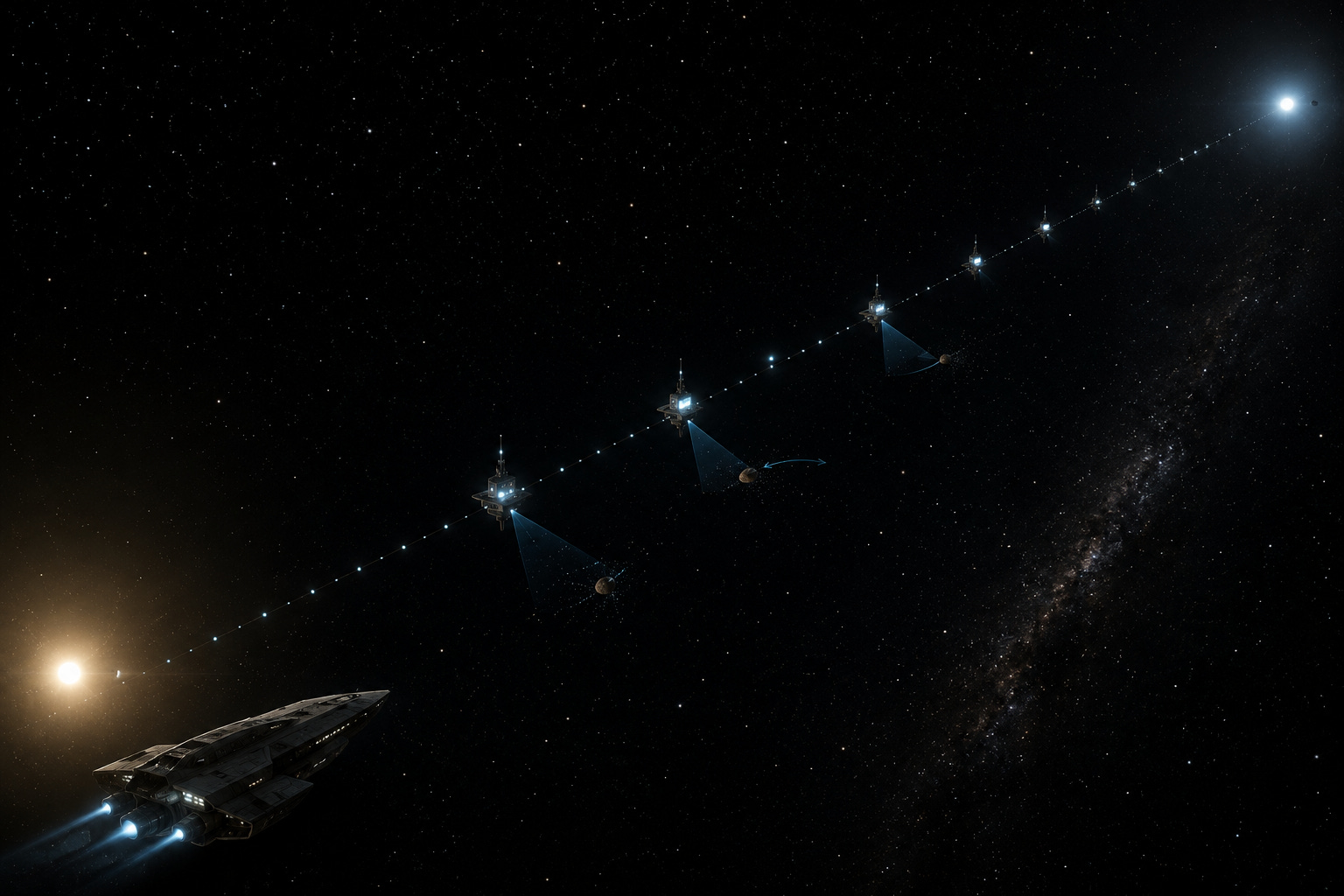
Imagine that before any human ship departs, countless robotic pathfinders are sent ahead. Most fail. Some succeed. Over time they establish the first interstellar railroad: a sparse but continuous chain of sensors, communication nodes, power sources, and hazard-clearing stations stretching between the stars.
Each station watches only a tiny region of space. Each knows the trajectory of approaching ships and can predict which objects may become dangerous. Most of the corridor is empty most of the time. But when a potentially hazardous object is identified, a station can act long before the ship arrives, nudging it slightly off course or otherwise ensuring it will not occupy the wrong place at the wrong time.
The remarkable thing is that very little mass actually needs to be moved. The total mass of dust occupying a narrow corridor several light-years long is surprisingly small. The challenge is not clearing vast quantities of material. The challenge is knowing where the dangerous particles are and having infrastructure already in place to deal with them.
The ship itself no longer needs godlike perception. The route provides the perception. The route has the eye.
At first glance, building such infrastructure sounds impossibly expensive. And it is. Sending sensors, power systems, communication nodes, and maintenance devices across interstellar distances would require an enormous investment of energy and time.
But that observation may be less devastating than it first appears.
Imagine asking in the early nineteenth century what it would cost to build a complete railroad from coast to coast. The answer would have been so staggering that it might have discouraged anyone from trying. Yet that is not how railroads were built.
First came trails. Then improved trails. Then dirt roads. Then local rail lines. Then connected rail networks. Each increment lowered the cost of the next increment.
Infrastructure is often self-amplifying.
Roads help build more roads. Railroads help build more railroads. Ports help build more ports. The very existence of infrastructure makes additional infrastructure cheaper to construct and maintain.
An interstellar railroad could evolve the same way. The first generation might consist of little more than navigation beacons. Later generations add sensors, power storage, maintenance drones, hazard-clearing systems, and traffic management. What begins as a fragile thread gradually becomes a robust transportation corridor.
The deepest irony is that the emptiness of space may be exactly what misleads us.
We look at the vast darkness between the stars and imagine a featureless void. But at sufficiently high speed, that seeming emptiness becomes a minefield. The danger does not come from there being a lot of material. It comes from there being just enough.
A civilization that wishes to travel slowly may need only ships.
A civilization that wishes to travel very fast may need tracks.
The first great breakthrough in interstellar travel may therefore not be a better engine. It may be the interstellar equivalent of a railroad tie.
For more than a century, science fiction has imagined that the road to the stars begins when we build a sufficiently advanced spacecraft. History suggests a different possibility. Again and again, transportation revolutions have depended less on vehicles than on infrastructure.
Perhaps the first civilization to routinely cross interstellar distances will not be the one that builds the fastest ship.
Perhaps it will be the one that lays the first tracks.