


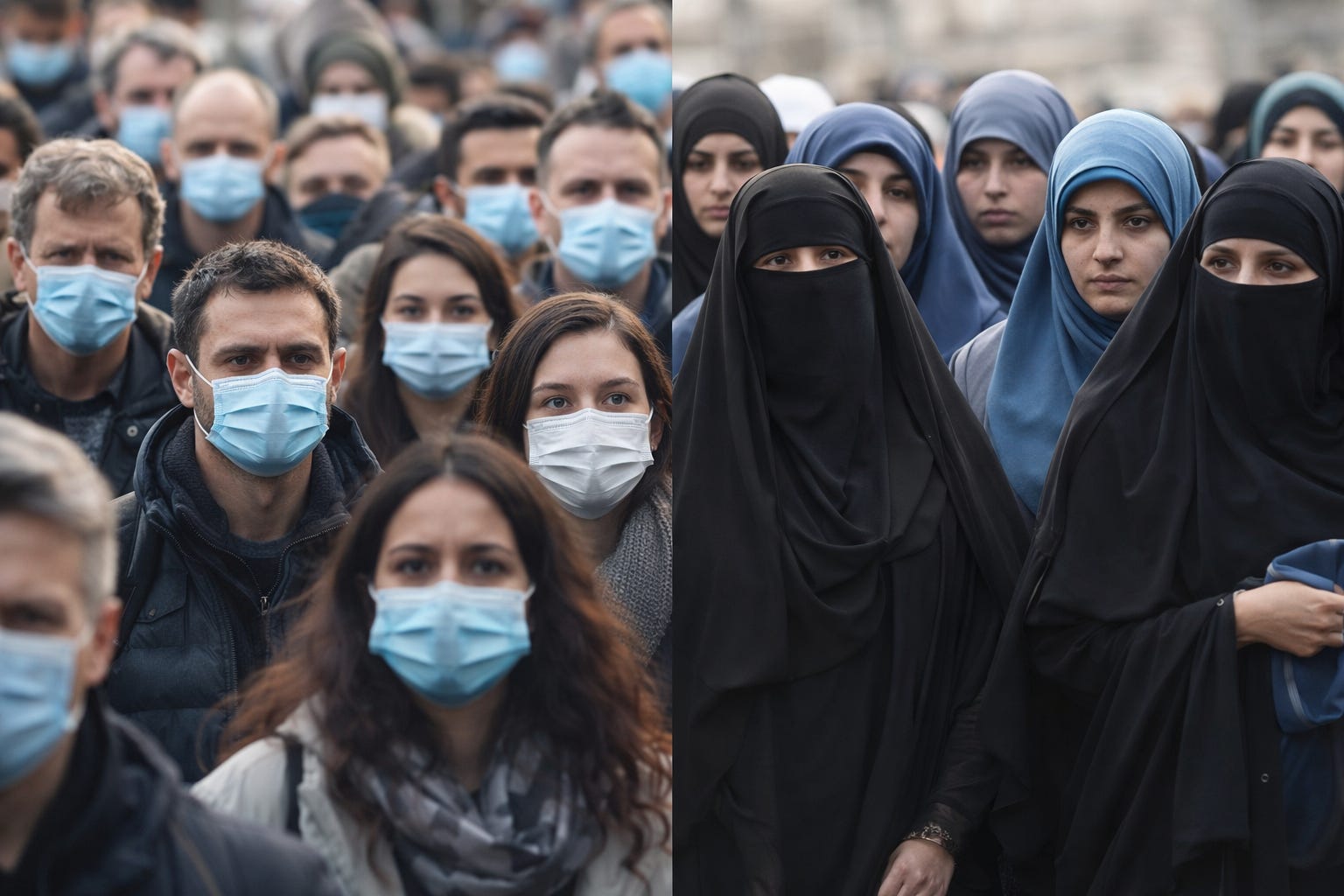
COVID revealed that Western societies are not post-authoritarian.
Under perceived existential threat, they rapidly adopted purity rituals, dress codes, speech taboos, social shunning, medical coercion, and sweeping suspensions of civil liberties — not reluctantly, but morally. Compliance was framed as virtue; dissent as contamination. To question proportionality or tradeoffs was not disagreement but heresy.
These were not exotic pathologies imported from elsewhere. They emerged organically, at scale, in societies that had long congratulated themselves on having outgrown such impulses. Peace had only veiled them. Fear unveiled them.
Having just lived through this, it is intellectually unserious to explain authoritarianism in other societies — Islamic or otherwise — as a product of uniquely corrupt cultures or irredeemable people. What differs across societies is not the presence of authoritarian potential, but the conditions under which it is activated, restrained, or sanctified.
The lesson of COVID should have been humility: a recognition that dress codes, purity laws, and moralized coercion are not relics of distant places or other religions, but latent human responses that can reappear anywhere, including here. Instead, many learned only how to redirect the same moral certainty outward.