


Most people think color blindness is about mixing up reds and greens.
They have no idea it’s actually making them health-blind.
We tend to imagine color vision evolved to help us identify objects: ripe fruit, colorful flowers, traffic lights.
But that’s probably not what it’s mainly for.
In 2006, my colleagues and I discovered that primate red-green color vision appears specially tuned to detect oxygenation changes in blood beneath the skin. Human skin is a living display, continuously broadcasting information about health, emotion, fatigue, stress, attraction, embarrassment, illness, and countless other physiological states.
In other words, color vision isn’t mainly about seeing colors.
It’s about seeing people.
That realization completely changes how we should think about color deficiency.
It’s not merely a quirky inconvenience in distinguishing certain hues. It’s a reduced ability to perceive some of the very information color vision evolved to detect.
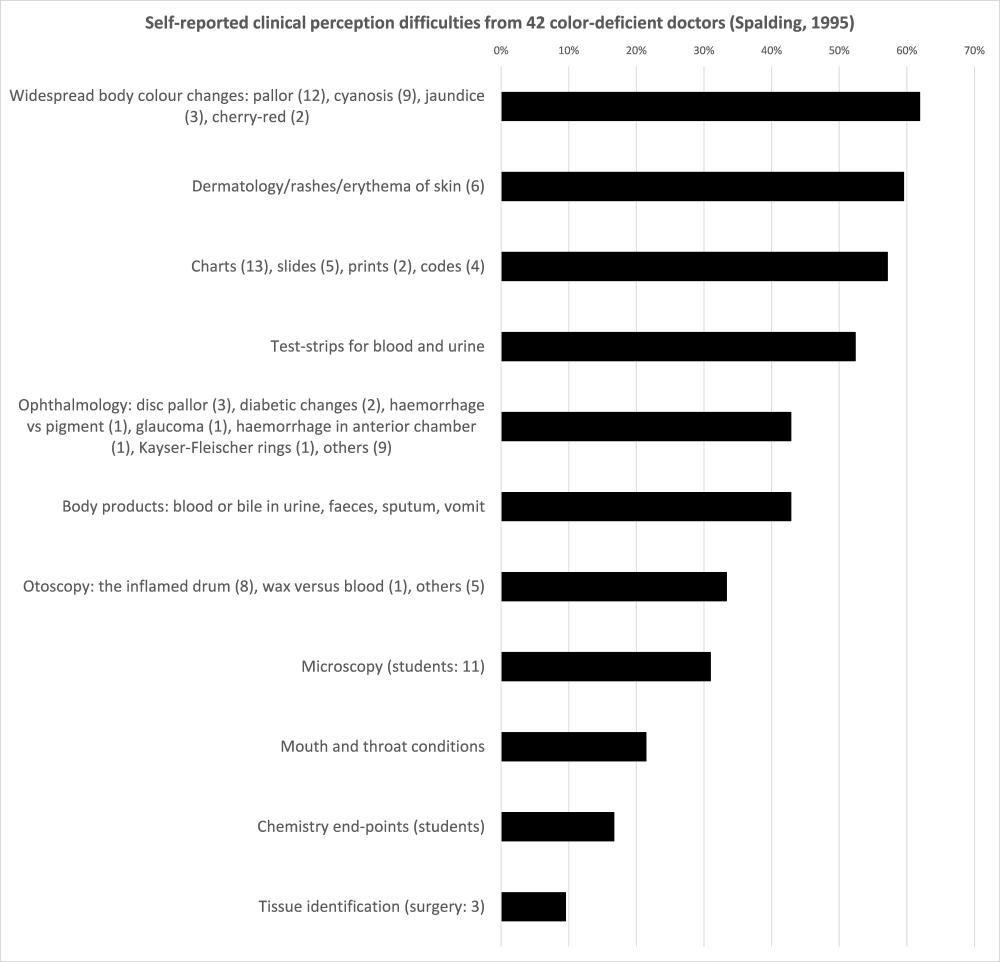
Color-deficient individuals have long reported difficulty seeing veins, pallor, cyanosis, jaundice, bruising, erythema, inflammation, and other medically important skin signals. Even John Dalton, the scientist after whom color blindness is named, famously remarked that he could scarcely distinguish mud from blood.
This matters in medicine, of course. Clinicians rely on skin color every day, often without realizing it. But the implications go far beyond hospitals and clinics.
Every day, all of us unconsciously read subtle color changes in the faces of the people around us. We notice when someone is embarrassed. Angry. Flushed. Sick. Exhausted. Stressed. Much of that information is carried by blood beneath the skin.
If you’re color deficient, some of those signals are simply harder to see.
Most color vision technologies are designed to help people distinguish colors.
That’s useful.
But it raises a deeper question:
What is color vision actually for?
Vino Optics is the only color vision technology built around the scientific discovery that human color vision appears specialized for perceiving oxygenation-related signals beneath the skin.
Our optical filters aren’t designed merely to make colors look different. They’re designed to enhance access to information that is already present in natural skin coloration.
Not just helping people see more colors.
Helping people see more of what color vision evolved to see.
Most people think color blindness means missing colors.
The deeper problem is missing some of the information those colors evolved to convey.
And that information is written all over the people around us.