


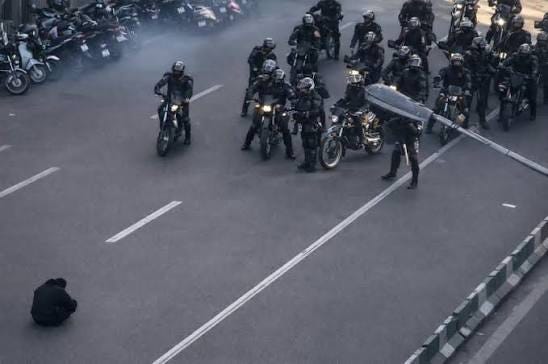
When talking about Iran and these waves of protest, it’s important to remind people what totalitarianism actually is — and why overthrowing it is mathematically difficult, even when most of the population opposes the regime.
Totalitarianism isn’t simply “top-down authoritarianism done really, really efficiently.” It’s a psychological state a society enters — a social mania or cult built on righteous narratives, purity tests, and new definitions of who is unclean and must be hated.
Crucially, it is enforced from the bottom up. Ordinary citizens — neighbors, coworkers, even family — become the monitors and enforcers, and they demand the top-down repression that inevitably follows. We saw a softer variant of this dynamic during Covid.
And it doesn’t require a majority. A sufficiently zealous minority can dominate public life while the rest of the population keeps its head down — intimidated, disorganized, and terrified of displaying anything less than full enthusiasm. Everyone knows they’re being watched.
So yes, in places like Iran it is entirely possible — and even common — for the vast majority to oppose the system that governs them.
That’s when outsiders ask the perennial question:
“If most people oppose the regime, why don’t they just overrun it?”
Even ignoring the regime’s capacity for violence, the answer lies in coordination mathematics.
The first person to raise their head, to openly resist or try to rally others, is the one most likely to be arrested, tortured, killed — and to see their family destroyed. No one wants to be that person. Each individual will only step forward if they’re confident that many others will step forward at the same time.
But everyone is thinking the same thing.
This is a society-scale variation of the Prisoner’s Dilemma: the individually rational strategy is to remain silent, even though the collectively rational strategy would be to rise up together. And so the stalemate persists — sometimes for generations.
What makes the present moment in Iran significant is that people have again pushed past that initial barrier — at least for now. Enough of them are taking simultaneous risks to make protest possible.
The next inflection point lies within the military and security services. There, the very same coordination dilemma repeats — only now among officers and commanders. Who defects first? Who risks everything, without knowing whether others will follow?
That is the brutal arithmetic of totalitarianism. Overthrowing it is never just a question of courage — it is a question of coordination under fear.