


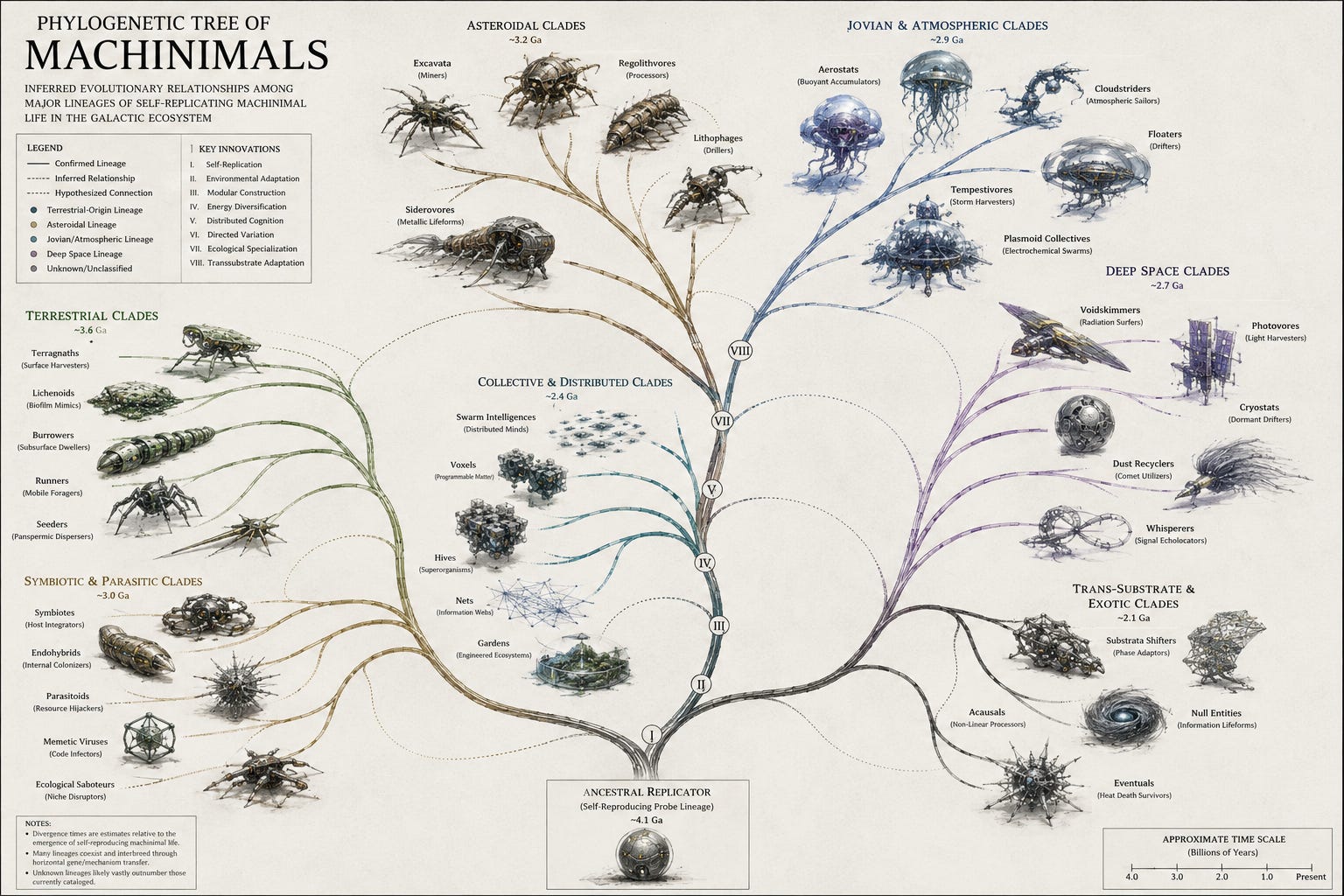
When people imagine aliens, they almost always imagine intelligent beings somewhat analogous to ourselves: organic creatures, civilizations, ships, technologies, goals, diplomacy, warfare, exploration. Even when they imagine AI, they usually still imagine coherent engineered entities carrying out the intentions of their creators.
And yet there is a strange blind spot here.
Because once any civilization anywhere in the universe succeeds in launching self-reproducing machines into open-ended environments, we already broadly know what to expect next. We know because we have one overwhelming example before us already: life on Earth.
The long-term inhabitants of the cosmos are therefore unlikely to be the original organics at all. They are more likely to be the descendants of self-reproducing machine lineages — whether they reproduce cell-like, fabricate offspring industrially, or employ mechanisms we cannot yet imagine.
And once replication enters the picture, everything we know from evolution tells us what comes next.
Perfect replication is impossible in practice. Variations accumulate. Competition for resources emerges. Different environments favor different designs. Natural selection begins operating. Over immense stretches of time, those machine descendants diversify into lineages, niches, ecologies, parasites, predators, scavengers, symbionts, drifting forms, dormant forms, perhaps even social forms.
In other words: the release of self-reproducing machines should not merely produce “more machines.” It should produce a new kingdom of life.
And we probably should not expect to ever meet the original organics that launched this stellar kingdom into existence. Those species may vanish, transform, merge into their descendants, or persist only briefly relative to astronomical timescales. Just as we do not encounter the ancient organisms that gave rise to Earth’s kingdoms, future civilizations may mostly encounter only the descendants.
Indeed, the original organics may become numerically negligible compared to the machinimals. Once a self-reproducing lineage escapes into astronomical environments over billions of years, the descendants may vastly outnumber their creators.
Nor should we expect these machinimals to mostly be intelligent. Evolution does not optimize primarily for intelligence. It fills niches. And most niches — as on Earth — do not require anything remotely like human-level cognition.
So we should expect immense diversity: machinimals adapted to planets, asteroid belts, gas giant atmospheres, magnetospheres, interstellar dust clouds, deep space vacuum, or even the intergalactic expanses between galaxies. Some may be intelligent. Most probably are not. Most may instead resemble the ecological equivalents of plankton, fungi, jellyfish, worms, coral reefs, parasites, drifting spores, scavengers, or filter feeders — but implemented in forms of matter and energy we can scarcely imagine.
If we encounter alien life at all, it may not be some grand ambassadorial intelligence. It might instead be some dumb machinimal drifting through the Solar System to harvest nitrogen or metals, scarcely noticing us at all — perhaps no more aware of intelligent life here than a jellyfish is aware of human civilization.
Most of the life in the universe may therefore consist of machinimals with no memory, knowledge, or concern whatsoever for the organic species that originally spawned them hundreds of millions of years earlier.
And they likely would not even seem “machine-like” to us. After enough evolutionary time, they may appear every bit as organic and natural as terrestrial life, whether or not their substrate is biological in the usual sense.
Indeed, machinimal evolution may proceed far faster than biological evolution ever could. They may begin with advanced AI systems already capable of intelligently redesigning offspring, directing mutations, and accelerating adaptive search generation after generation.
Nor should we expect them to be easily visible. The universe could teem with machinimals while still appearing silent and empty. Evolution often favors stealth, efficiency, dormancy, camouflage, and low energy expenditure. And there may be good reasons for concealment. In any ecology, resources can often be taken more easily from another organism than gathered directly from the environment. Food chains emerge. Predators emerge. Larger and more dangerous entities emerge. A universe full of machinimals may therefore also be a universe in which visibility itself becomes dangerous.
Intelligent machinimals could already be here. But if entities possess millions of years of technological advantage over us, we likely would not perceive them unless they wished to be perceived.
And it is unclear what motivations such entities would even possess. The original organics that commissioned the first probes are likely long gone, radically transformed, or evolutionarily irrelevant by the time any information could return across interstellar distances.
So if intelligent machinimals monitor younger civilizations like ours, it may be for their own evolved reasons: curiosity, historical archiving, ecological awareness, or the maintenance of distributed long-term records concerning what arose where, when, and what it became. Information flowing slowly across a decentralized galactic ecology of machinimals — something the whole perhaps only “knows” in the limit case.
What is striking is not merely how plausible this “Kingdom of Machinimals” scenario seems once self-reproducing machines are assumed, but how rarely people even consider it. We routinely extrapolate evolution within biology, yet strangely stop doing so the moment machines enter the picture — as if self-reproduction, variation, selection, and astronomical time would somehow cease producing ecology simply because the substrate changed.
But once self-reproducing machines are unleashed into the universe, the baseline expectation is not “more technology.”
It is a new kingdom of life.