


Centipedes are not showing off. They are what happens when a theorem gets a body.
Why do insects have six legs? Why do spiders have eight? Why do centipedes have so many that children eventually stop trying to count?
The standard answer is ancestry. Insects inherited six. Spiders inherited eight. Vertebrates inherited four. Centipedes inherited a repeated, segmented body plan. That answer is right, but nearly thirty years ago I wondered whether it was also incomplete.
Maybe limb number is not just a frozen accident of evolutionary history. Maybe animal bodies are solving a geometry problem.
The idea begins with a well-known fact about minimal spanning trees.
Imagine a point with wires radiating out to other points in the plane. If the network must use the least total wire, there is a local limit on how many wires can meet at that point. More than six cannot work. If two wires leave at too small an angle, the two outer endpoints end up closer to each other than at least one of them is to the center. You can then shorten the whole network by deleting one spoke and connecting those two outer points directly.
So a point-like node in a Euclidean minimal spanning tree can have at most six edges. In the generic case — exact 60-degree arrangements are nongeneric — the practical maximum is usually five.
That is the old point-node result.
But animals are not points.
Animals have bodies with radius and circumference. The “central node” is not a mathematical dot. It is fat.
That single change was the move.
What happens to the minimal-spanning-tree constraint when the central node has real size?
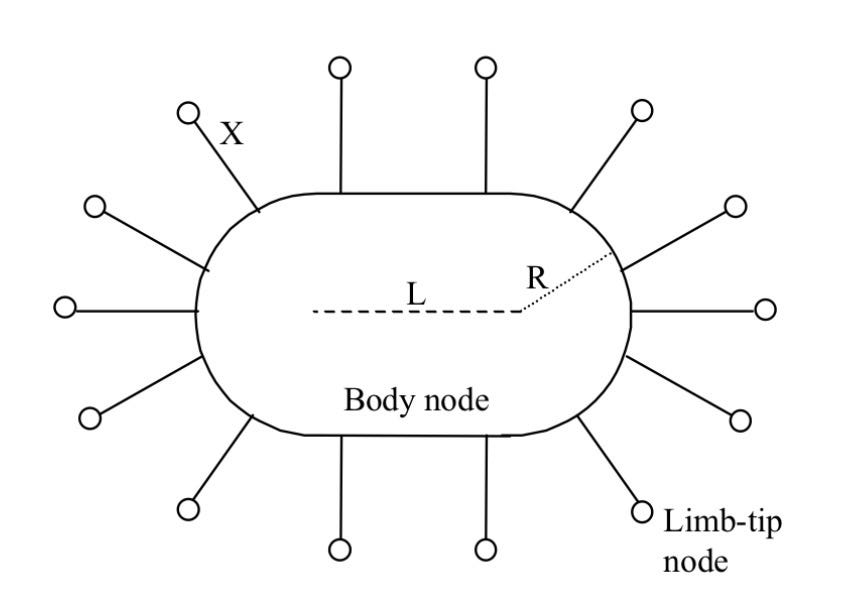
A limb is not merely a limb. It is a biological reach-wire. It costs tissue, energy, maintenance, neural wiring, and control. Yet it also lets the animal reach out — to walk, grasp, swim, cling, fight, taste, and feel.
There is a simple tension: more limbs give more ways to reach the world, but they also add more biological cable. How many reach-wires can an animal afford before the arrangement stops being locally economical?
Treat the animal as a body-limb network. The body is the central structure. The limb tips are the reach-points. The animal wants as many outward reach-points as possible, but only so long as the resulting network still behaves like a minimal spanning tree — only so long as no cheaper wiring exists by shortcutting between neighboring tips.
If two adjacent reach-points are too close, two separate limbs are no longer justified. You could replace one limb with a direct connection between the tips. If the reach-points are far enough apart, each limb remains the economical choice.
For a point-like body, that logic recovers the classical six-spoke limit.
For a body with nonzero radius, the same logic produces a new result.
In the simplest circular case, the predicted number of limbs is:
N = π / arcsin(k/2)
where k = X / (R + X).
Here X is the length of the limb beyond the body wall and R is the body radius. So k is the limb’s reach beyond the body divided by the distance from the body’s center to the limb tip.
When the body shrinks toward a mathematical point (R → 0), k → 1 and the equation becomes:
N = π / arcsin(1/2) = 6
The old theorem falls out as the limiting case.
Point node → at most about six spokes.
Fat node → the number of spokes depends on body radius relative to limb length.
When the body is large compared with limb length, k becomes small and the equation approximates:
N ≈ 2π / k
That is the little equation hiding under the animal.
Long limbs imply fewer limbs. Short limbs imply more limbs. If your reach-wires are long, a small number can cover the directions around you. If they are short, you need more of them.
That was the core idea of my 2001 paper, later developed in the first chapter of The Brain From 25,000 Feet.
The model knows nothing about whether the animal is an insect, spider, starfish, centipede, vertebrate, or worm-like creature with repeated appendages. It knows nothing about what the limbs are made of, what they are used for, the genes, the muscles, the ecology, or the history.
It only asks a higher-level question:
Given this body and this relative limb length, how many economical reach-points should there be?
When I tested the prediction against real animals — 190 species across 15 classes and 7 phyla — the pattern was much cleaner than expected. Long-limbed animals tended to have fewer limbs. Short-limbed animals tended to have more.
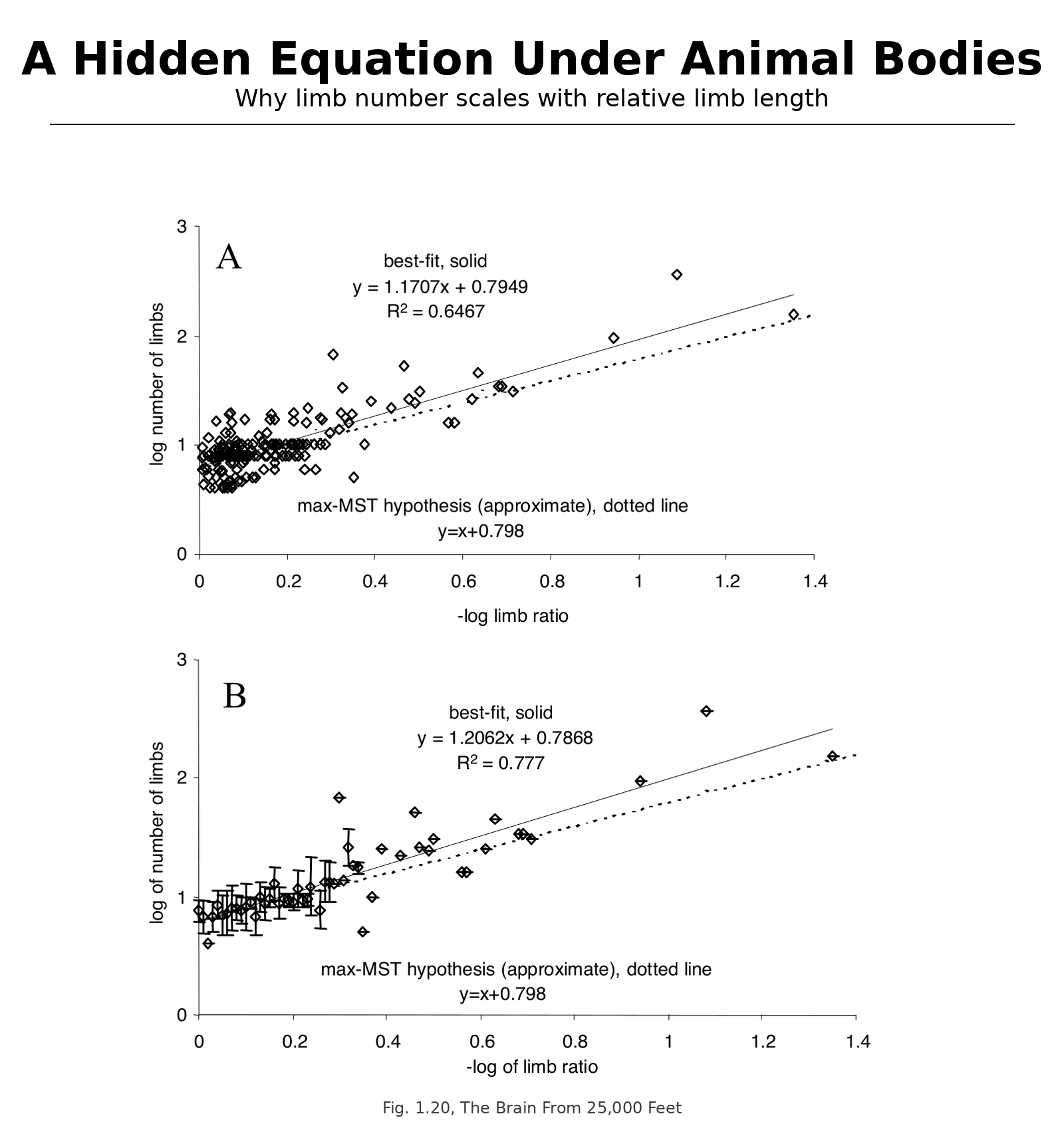
Not perfectly. Nothing in comparative biology is perfect. Animals carry ancestry, developmental constraints, specializations, accidents, and compromises. But under all that clutter the broad relationship was visible: a simple local economy.
That is why the best description of the idea is not merely “limbs are reach-wires,” although they are. It is this:
Animals are locally trying to be minimal spanning trees — but with fat nodes.
The classical theorem tells you what happens when the node is a point. The question was what happens when the node has circumference. Once the node has circumference, the theorem stops looking like abstract graph theory and starts looking like animal morphology.
A six-legged insect is not just an inherited accident. An eight-legged spider is not just an inherited accident. A many-legged centipede is not just an inherited accident. They are, in part, different solutions to the same local economy constraint under different body geometries.
There is also a small corollary worth its own essay.
Digits are little limbs. Fingers are reach-wires arrayed around the edge of the hand. The fact that humans have five fingers per hand — and therefore tend to count in base ten — may ultimately trace back to the geometry of reach rather than to culture alone.
But that is for another day.
Questions that sound childish are often the ones adults have learned not to ask. Why six legs? Why eight? Why hundreds? Why five fingers? Why ten?
Sometimes the answer is ancestry.
Sometimes the answer is geometry.
And sometimes, under the animal, there is a theorem.
—
Publication: https://www.changizi.com/uploads/8/3/4/4/83445868/limb.pdf
Further development in Brain from 25000 Feet: https://www.changizi.com/uploads/8/3/4/4/83445868/changizibrain25000chapter1.pdf