


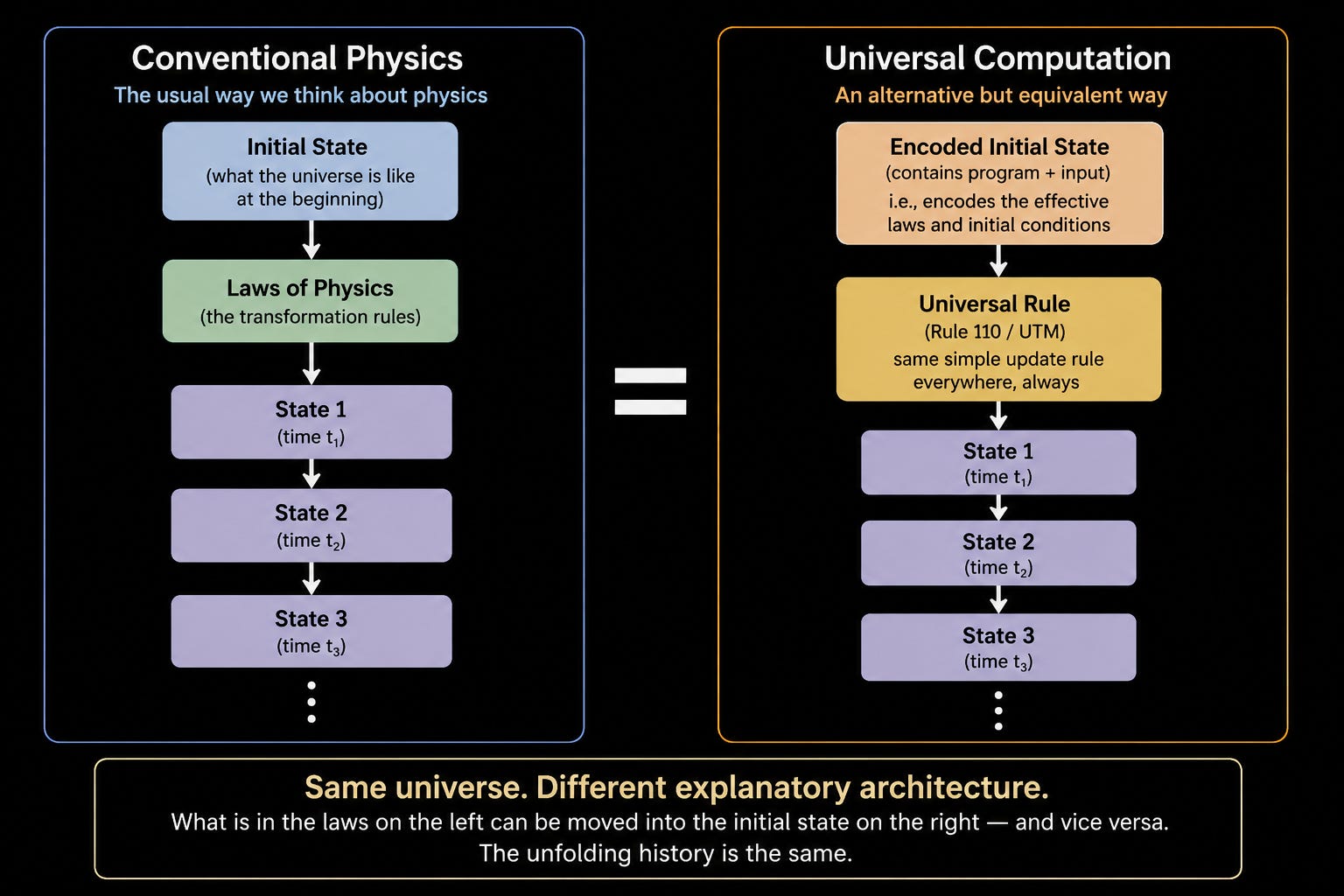
There is a very different way to think about the foundations of physics.
The usual picture is familiar. The universe begins in some initial state, and the laws of physics determine how that state evolves from one moment to the next. The initial state supplies the starting point; the laws supply the transformations. Each new state follows from applying those laws to the preceding state.
In computational terms, the laws of physics are the algorithm, and the initial state is the input. The algorithm computes the next state of the universe, that output becomes the input for the following step, and the process continues indefinitely.
But computation can be organized in another way.
Consider the distinction between an ordinary Turing machine and a universal Turing machine. In an ordinary Turing machine, the transition function is specialized for the particular computation being performed. The machine itself contains the algorithm, while the tape supplies the input.
A universal Turing machine works differently. Its own transition function is fixed once and for all. Written on its tape are both a description of another machine—the program to be executed—and that program’s input. What had previously been built into the specialized machine has now been transferred onto the tape. The universal machine itself becomes a general-purpose interpreter, repeatedly carrying out the same fixed machinery on whatever program and input have been encoded in its initial state.
The contrast can be seen even more cleanly with one-dimensional cellular automata.
Imagine a row of cells, each of which can be either on or off. At each time step, every cell changes according to a local rule that looks only at that cell and its immediate neighbors. There are 256 possible elementary local rules of this kind.
The ordinary procedure is to choose one of those rules, choose an initial row of cells, and then watch the system evolve. This mirrors the conventional picture of physics:
Initial state + transformation laws → history of the universe
Different rules produce very different characteristic forms of behavior. The rule therefore appears to carry most of the explanatory burden.
But one of those elementary cellular-automaton rules—Rule 110—is special. Stephen Wolfram identified its remarkable behavior, and Matthew Cook proved that it is computationally universal. With a sufficiently constructed initial configuration, Rule 110 can emulate any Turing-machine computation.
This means we no longer need to select a different local transformation rule for each different computational world. We can hold Rule 110 fixed and encode both the program and its input into the initial configuration itself.
We could therefore have arbitrarily different simulated universes, exhibiting arbitrarily different effective laws, while every one of them evolves according to exactly the same primitive local rule. All of the differences between those universes—including what would ordinarily be called their laws—would be encoded in their initial states.
The universal update rule would still be necessary, of course, but it would contribute almost none of the information specific to any particular universe. It would simply execute whatever had been encoded into the starting configuration. The real explanatory work would be done by the initial state.
This flips the usual way of thinking about physics on its head.
Given a universe exhibiting some particular laws, there are two very different ways its evolution might be represented.
In the conventional representation, the universe has a relatively contingent initial state together with substantive transformation laws. Those laws explain why the universe unfolds in its characteristic fashion.
In the alternative representation, the universe has a fixed universal transformation rule, while its initial state encodes both its effective laws and what we would ordinarily call its initial conditions. The universal rule serves merely as general computational infrastructure. The explanation for why that universe unfolds as it does lies in the structure of the initial state.
These are not necessarily two different universes. They can be two computationally equivalent descriptions of the same unfolding. What is built into the transformation rule in one representation can be transferred into the initial state in another.
This kind of equivalence is well known in computer science. A specialized machine can have a particular algorithm built into its transition function, or a universal machine can keep its transition function fixed and receive a description of that algorithm as part of its input.
Applied to physics, however, the second representation is much less intuitive. Physics normally treats the laws as the deep explanatory objects and the initial conditions as the comparatively accidental facts to which those laws are applied. The computational reformulation permits the exact reverse: the transformation rule becomes nearly content-free, while the initial state contains the structure responsible for the universe’s apparent laws.
I find this interesting because, although I am an outsider to academic foundations of physics, I am not familiar with physicists adopting this second representation as a central way of thinking about nature. Physics generally seeks the correct fundamental laws governing how the universe evolves, while treating the initial state as the contingent material upon which those laws act. It does not ordinarily begin by fixing a universal update rule and asking what principle could determine an initial state that encodes the effective laws of our universe.
The two formulations may ultimately be equivalent. But equivalent formulations need not be equally fruitful. They assign explanatory importance to different objects, make different questions appear fundamental, and suggest different routes toward a theory.
Universal computation shows that the distinction between law and initial condition may be representational rather than fundamental.