


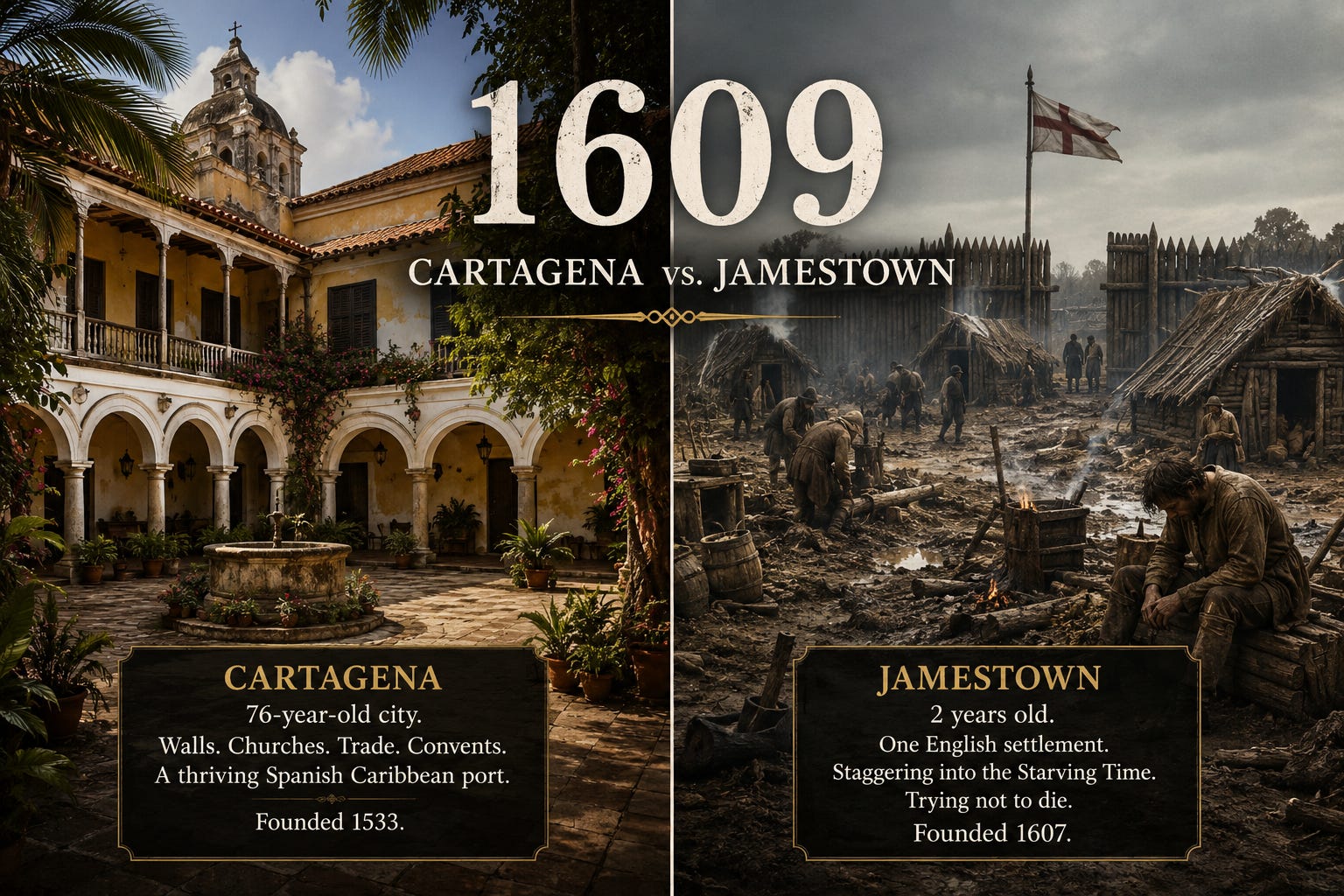
I’m in Cartagena, staying at the Hotel Charleston Santa Teresa, and I’m still astounded by how far ahead the Spanish already were in what is now Colombia while the future United States was still barely a glint in history’s eye.
The building that is now this hotel began as a Carmelite convent. Its founding act was signed in 1609. By then, Cartagena had already been a functioning Spanish city for 76 years—founded in 1533 as a major Caribbean port, with walls, churches, trade, and enough accumulated wealth to support a new religious house.
Meanwhile, in 1609, on the other side of the continent that would one day become the United States, the English had managed exactly one permanent settlement: Jamestown. It was two years old, staggering into the Starving Time, and about to lose most of its people to hunger, disease, and desperation. There were no other English towns. Plymouth was still eleven years away. The very idea of a lasting English colonial society remained mostly theoretical.
So while Cartagena was founding convents, the English experiment in North America was still trying not to die.
The gap is almost comic.